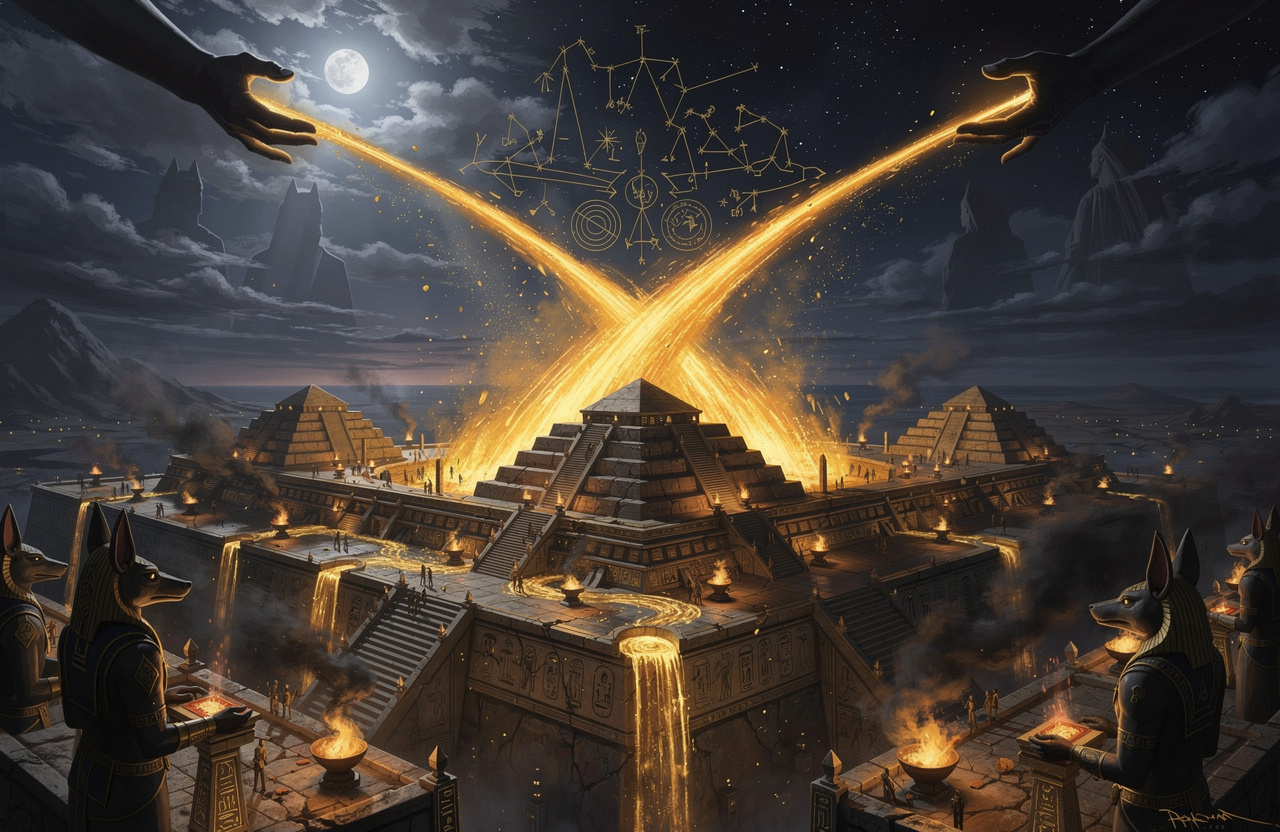
There's a picture we're shown from childhood: poor Africa, helped by the rich West. Convoys of humanitarian aid, charity concerts for the starving, billions for "development." It's a touching picture. And almost entirely upside down. Because if you add up all the money flows honestly — in and out — it turns out the West does not feed Africa; Africa feeds the West. The continent gives away more than it receives. Every year.
Counting both directions
Aid is the flow you can see. There are reports about it. And there are flows that are hard to see, and they are bigger.
First, debt service. African countries owe external creditors — private funds, banks, the IMF, the World Bank. And every year they pay interest on those debts. These payments are constant, obligatory, and often exceed everything that comes in as aid.
Second, the export of raw materials. Out of Africa flow oil, gas, gold, diamonds, cobalt, copper, uranium — the things without which no Western economy and no smartphone works. But these are mostly extracted and sold by foreign companies. The profit goes to wherever the owner is registered. The continent is left with workers' wages and a tax it still has to manage to collect.
Third, capital flight: repatriated profits of multinationals, money slipping into offshore accounts, illicit financial flows. The money earned on African resources physically leaves the continent faster than any aid arrives.
Add it all up, and the balance goes deeply negative. Aid and loans flow into Africa. Debt service, resource profit, and flighted capital flow out. And more flows out. This is not charity. It's a pump.
How the debt pump works
The scheme is painfully simple, and it repeats from country to country. A state is given a loan — for infrastructure, for "development," to rescue the budget. The loan comes with interest. To pay the interest, you need hard currency. To earn hard currency, the country is pushed to export raw materials — the very ones foreign companies profit from.
You get a closed loop. Debt forces you to pump out raw materials. The materials leave the country for a pittance. There's still not enough money for the interest. A new loan is taken to pay off the old one. The debt grows. An engineer would recognize this not as a bug but as the system's normal operating mode: the pump is tuned to push one way.
And here's the key: this is not a glitch of colonialism. It is its continuation by other means. Once, resources were carried off by soldiers and steamships. Now, by loan contracts and interest rates. Less bloody, more efficient, and formally everyone agreed — the country signed, after all.
"Aid" that cements dependency
The most cunning thing is the word "aid." Aid often comes tied: money is given on condition the country buy goods or services from companies in the donor country. So money formally gifted returns at once as orders for Western firms. Aid that loops back to the giver.
Aid often comes with political conditions: open your markets, privatize state firms, scrap subsidies for your own farmers. After that, local production can't survive competition with cheap imports, the country gets hooked on imported food and goods — and grows more dependent still. There seems to be aid, yet there is less self-reliance.
In the book's terms this is pure Isfet — the inversion of fair exchange. In a fair exchange you give something and receive something, and both sides come out ahead. Here the exchange is turned inside out: the one who gives the most (resources, labor, interest) is labeled the "aid recipient." And the one who extracts is labeled the "benefactor." A parasite doesn't just drink the resource — it rewrites the nameplate so the donor looks like the dependent.
Where the ordinary person is in this
In Africa, he is at the very bottom of the pump. Beneath his feet is some of the richest land on Earth, and his pocket is empty, because the profit from that land flows to a place he has never been. His country pays on debts taken before he was born, on terms he never chose.
But don't flatter yourself that it's all "over there." The same logic works for any debtor in any country: you create value, and the interest on it flows upward. Africa is simply the most honest, most exposed example of how the pump works. On Africa you can clearly see what comfort hides in rich countries.
The answer: the MAAT token and DAO
The African paradox rests on the fact that negotiations always happen one at a time: one country against a network of creditors, funds, and corporations with a single interest and shared coordination. One arrow against a bundle of arrows. The outcome is decided in advance.
MAAT builds that very network for those who never had one. The MAAT token is membership in a cooperative where millions of scattered people gather their votes into a single bundle, and where the rule is one human, one vote, not "whoever has more money and resources dictates." Governance runs through a DAO — a decentralized organization with a transparent treasury, where every movement of funds is visible to all, and capital cannot quietly slip offshore on someone else's signature.
The pump works only while one end of it is scattered loners and the other a coordinated network. MAAT removes that asymmetry. The entry is simple: read the book, take the token, get the vote — and stand on the side that, at last, has a bundle instead of a single arrow.