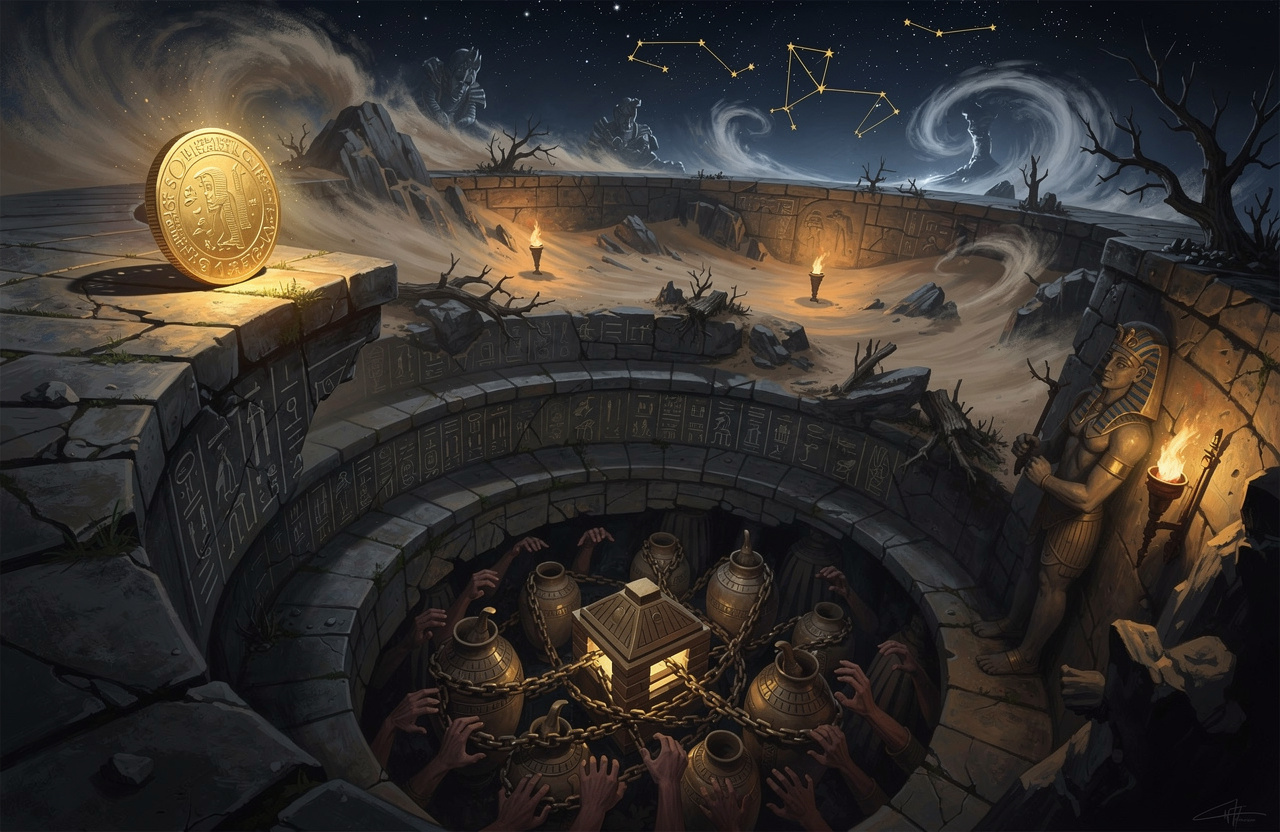
Most people think a debt crisis is when someone borrows too much and miscalculates. An accident, a mistake, greed, bad luck. Sometimes that's true. But look not at one country but at dozens at once, over decades, and something unpleasant emerges: this is not a series of accidents. It's a machine. It has an input, an output, and between them always the same three steps. Loan. Conditions. Asset grab.
Step one: a loan that can't be repaid
The trap begins with generosity. A country — especially one not wealthy, with resources and ambitions — is offered a large loan. Often for a noble purpose: roads, dams, energy, "development."
Two details turn this loan into a trap rather than help. First: it's in dollars. The country earns in its own currency but owes in someone else's — so the lever over its debt isn't in its hands. Second: the sums are issued against inflated growth forecasts. The economy is promised a leap that sober arithmetic says won't happen, and against that imaginary leap a very real debt is hung. And often the money barely reaches the country at all: the loan goes to Western contractors for construction, the money returns to the top — while the debt stays at the bottom.
An engineer would call it a planted vulnerability: a weakness built into the system at install time. After that, you just wait for it to trigger.
Step two: conditions instead of sovereignty
Sooner or later there's nothing left to pay with. And here comes the "rescuer" — the IMF, the World Bank, a creditor consortium — with a new loan. To pay off the old one. `while (true) { debt++; }` — a loop with no natural exit.
But the new loan no longer comes free. Attached is a package of conditions known in the jargon as "structural reforms." Translated into human: privatize state assets, cut pensions and subsidies, open markets to foreign capital, devalue the currency. Each condition narrows the space in which the country can govern itself. With every tranche it is less the operator of its own economy and more a user with reduced privileges, clearing every budget with an external administrator.
The Fed raises rates and the debt grows heavier on its own. The conditions tighten. The noose draws closed not because someone is being a villain right now, but because that's how the structure is built.
Step three: buying assets for a song
The finale is the most profitable for those who set the machine in motion. The bled-out country is forced to sell off its property: ports, airports, water, energy, land. And it sells in a crisis — that is, at the worst possible moment for itself.
The buyer knows the seller is desperate and pays a small fraction of the real price. That is how a fence for stolen goods works. Out of a planned 50 billion euros, Greece raised about 2.6 billion — five percent of the plan. Argentina sold its oil company for pennies, then bought it back for billions. The difference settles, every time, at the top of the pyramid — with those who lent the loan at the input and buy the assets at the output. The circle closes. The resource has flowed exactly where it was meant to.
Why this is Isfet, not just business
Defenders of the system will say: this is a normal market, the creditor has the right to recover what's owed, nobody forced anyone to borrow. Formally — yes. But look at the structure of the exchange.
In fair exchange both sides come out ahead: you gave, you received in proportion; I took, I grew stronger. In the debt trap it's the reverse: one side weakens again and again, the other strengthens again and again, for decades. That is not exchange; it's latching on. The ancient Egyptians would have called it Isfet — the inversion of fair exchange, a structure that draws the resource out of a living organism and puts nothing back. The book compares it directly to a parasite that sucks gradually: the victim weakens but doesn't die, because a dead donor is useless. The country is kept precisely in a state of permanent, just-bearable debt — so it can keep being milked.
Where is the ordinary person in this
At the very end of the chain. The assets bought up at step three are his water, his power plants, his minerals, his pension system. The debt those things are pledged against hangs on him through taxes and slashed spending. And he'll be told the culprit is "a bad government," "corruption," or "global conditions" — anything but the machine itself. That is the parasite's strength: it's invisible, and the pain is blamed on anything but it.
And above all — nobody asked him. The loan was taken without him, the conditions signed over his head, the assets sold past him. His vote, like a fund shareholder's, formally exists, but an intermediary wields it.
The answer: the MAAT token and DAO
The machine rests on one condition: the victims are scattered while the creditors are coordinated. One player with a ready template against millions of loners ground down in turn. There is only one way to break the machine — gather the loners into a network symmetric to the creditors' network, but built in favor of people, and transparent.
That is MAAT. The MAAT token is membership in a cooperative and a single vote on the principle of one human, one vote — not "one dollar, one vote" like the debt holders. Governance runs through a DAO, a decentralized organization with a transparent treasury where every movement of funds is visible to all. A shared treasury that can't be frozen from someone else's office, and a shared vote that grows with the number of members — that is exactly what people never had at any of the three steps of the trap. The entry is simple: read the book, take the token, get your vote — and stop being the last line in someone else's algorithm that reads "take the assets."