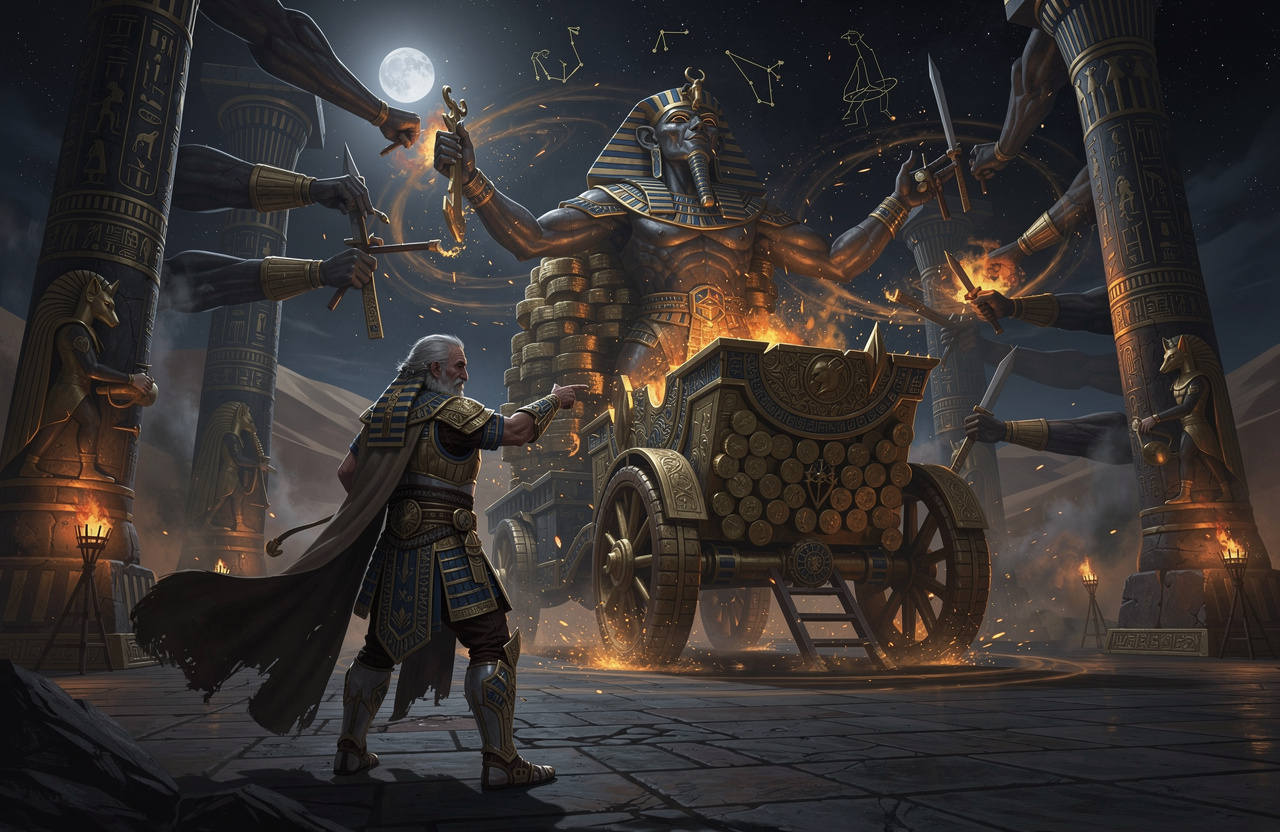
When the radical critic of a system warns you about its harm, it is easy to wave it off: well, an activist, what do you expect. But when the warning comes from a man who ran that system himself, commanded it in the largest war in history and was president of a superpower — you cannot wave it off anymore. That is exactly how one of the most important warnings of the 20th century came about. It was given by a general.
The general who said "be careful"
On January 17, 1961, U.S. President Dwight Eisenhower gave his farewell address as he handed over power. Eisenhower was no pacifist and no theorist. He was a five-star general, the Supreme Allied Commander in the Second World War, the man who organized the Normandy landings. If anyone understood the war machine from the inside, it was him.
And in his farewell address this man uttered a phrase that went down in history: we must guard against the acquisition of unwarranted influence, "whether sought or unsought," by the military-industrial complex. He essentially introduced the term into wide circulation. It is known that an even sharper version existed in the drafts — "military-industrial-congressional complex," explicitly naming Congress — but the word was removed in the end so as not to quarrel with legislators.
What exactly he saw
Eisenhower described something new for America. Earlier the U.S. did not keep a vast permanent arms industry — armies were raised for a war and disbanded after. But after the Second World War and into the Cold War, a permanent, gigantic fusion formed for the first time: the armed forces, plus a private industry that profits from weapons, plus politicians who depend on that industry (jobs, contracts in their districts, campaign funding).
And here is the trap he spotted. Such a system acquires its own interest — not the security of the country, but its own growth. To an industry that lives on military orders, peace is unprofitable. What is profitable is threat, tension, a new round of armament. Not necessarily a hot war — a constant sense of danger is enough, against which budgets are extracted.
An engineer would say: a process was built into the system whose optimization function is tuned for "more contracts," not "fewer wars." And that process begins to generate demand for its own work.
A self-sustaining cycle
This fits perfectly with what the book underlying this project describes: war is not a way to solve a problem but a way to feed. The military-industrial complex is the institutional form of that feeding. The book notes directly how, out of recent conflicts, the military-industrial complex emerges with record profits and contracts for decades ahead. This is not a side effect of war — for this layer it is the main product.
The cycle is self-sustaining: threat → budget → weapons → new threat. Each link is financially interested in the next. No one inside needs to be a villain who wants deaths. It is enough for each to simply optimize his piece — the factory wants orders, the general wants new hardware, the congressman wants jobs in his district. The sum of these rational wishes is a machine that needs an eternal threat.
Where fact ends and myth begins
Let's draw the line honestly. Myth: "The military-industrial complex is a secret council sitting in a bunker, igniting every war on the planet from a single script." There is no single bunker and no single script. This is not a conspiracy of a handful of people, but a structural bias in a whole system of incentives.
Fact: the military-industrial complex, as a fusion of the army, the defense industry and politics, genuinely exists, genuinely wields enormous lobbying influence, and is genuinely interested, structurally, in a permanent level of threat. And the warning came not from a conspiracy theorist but from an outgoing president-general in an official speech. It is a document; you can read it in full.
The most striking thing in this story is that the warning was given and heard by everyone, and the system still grew many times over. That is the best lesson on how such structures work: they cannot be stopped by one correct speech, even one spoken from the very summit of power. What holds them is not secrecy but incentives.
Where is the ordinary person
He pays for it twice. First in taxes: money that could go to schools, medicine, roads goes instead into budgets whose size is set by the "level of threat" — and a high threat level is profitable to maintain. And then, if the threat does turn into war, he pays in blood as well. Yet he has no vote in this system: budgets are agreed where the lobbyist outweighs the voter.
The answer: the MAAT token and DAO
The military-industrial complex is a network of incentives in which those interested in war have powerful coordination and lobbying, while those interested in peace have nothing but scattered indignation. Eisenhower warned, but gave no instrument. The counterweight is an organized voice for those who pay for war but do not want it.
That is MAAT. The MAAT token is membership in a cooperative and a single vote, on the principle one human, one vote — not "whoever has the stronger lobby sets the threat budget." Governance runs through a DAO, a decentralized organization with a transparent treasury where every movement of funds is visible and no one can quietly turn fear into someone's contract. Eisenhower gave the warning. MAAT is an attempt to give what he lacked: a structure capable of carrying that warning out. The entry is simple: read the book, take the token, get your vote.