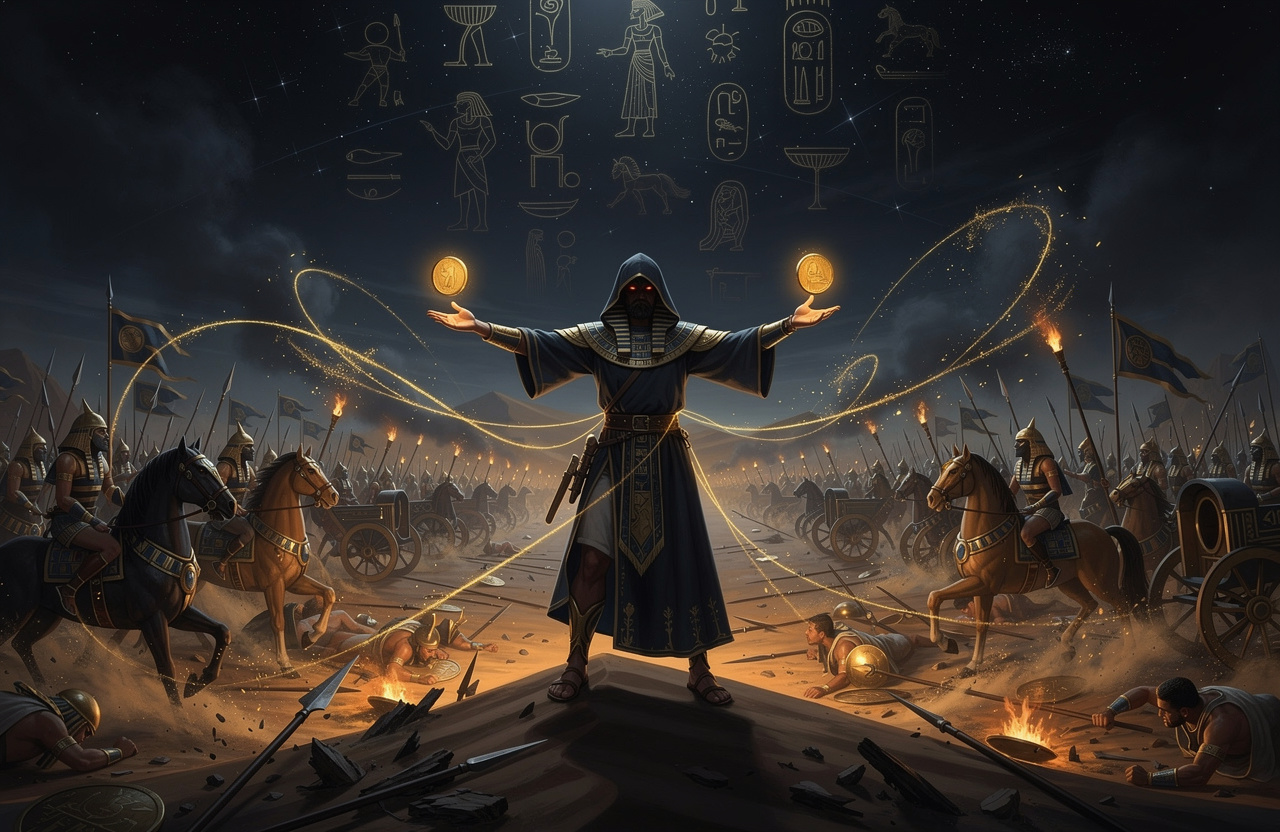
War looks like a clash of two camps: here are ours, there are the enemy, a front line between them. But if you look not at the trenches but at the flows of money, the line disappears. Because capital organized as a network does not fight — it earns. And in the First World War, as in the wars before it, there were nodes standing on both sides of the front at once. The book puts it with merciless brevity: they funded both sides of the wars, and it doesn't matter who wins — the debt remains.
A principle older than cannon
First, the mechanics, because without them the names explain nothing. An ordinary person, banker, or merchant is tied to his country. War comes — he bets on his own side. It wins, he profits; it loses, he's ruined. Clear and risky.
Now picture capital with nodes both here and there — on both sides of the border. To such a network it doesn't matter who wins. It funds both, at interest. After the war the victor owes it money. And the loser owes it money. The war ends, the front is erased, and the IOUs stay with the one who lent to everyone. An engineer would call it perfect fault tolerance: one node falls, the system keeps earning on the rest.
This principle was perfected long before 1914 — by cross-border banking houses able to move money between warring capitals faster than armies. The First World War was simply its grand demonstration: the first industrial conflict, burning money on an unthinkable scale. And where money burns, someone is lending it.
The money for war arrives before the shells
Twentieth-century war is not only soldiers. It is steel, gunpowder, rifles, ships, bread for millions of mobilized men. All of it must be bought in advance and on credit, because taxes aren't enough. So warring states first go not to the front but to the lenders — to place war loans, sell bonds, borrow against future victories.
In the US, formally neutral in the early years, the largest financial houses became creditors to the Entente powers — arranging enormous loans and purchases. This is historical fact, not theory: American capital was earning on the European slaughter long before America entered it officially. Industry shipped shells across the ocean, banks financed the purchases, the interest dripped in.
And here's the subtle point. Capital that lends to one side is rarely fully "patriotic." The financial world of that era was tightly interwoven through families, partnerships, and correspondent ties. Money, like water, seeped across any front — through neutral countries, through chains of intermediaries. Airtight partitions between "enemy" economies are something money almost never knows.
A family on both sides of the front
The clearest symbol of this is the fate of one banking family. The Warburg brothers: one, Paul, moved to the US and became one of the architects of the American Federal Reserve. The other, Max, stayed in Germany and headed a major Hamburg bank, taking part in the financial machine of the Kaiser's Germany. Two brothers — on opposite sides of a world war, each handling the big money of his power.
Here we must honestly separate fact from myth. The myth: "the brothers coordinated at night to secretly decide the war's outcome." There's no evidence of secret collusion, and to present it that way is to lie. The fact is more interesting and frightening: the very structure of the financial world was such that kinship, friendship, and business ties ran through both warring camps. Capital needed no secret conspiracy to stand on both sides — it stood there by its nature, as a network for which borders are merely an obstacle to transferring funds.
Who pays the war's bills
And now the point of it all. The war ended in 1918. Millions dead, Europe in ruins. But the debts remained. The victors owed creditors for the war loans. Defeated Germany was made to pay colossal reparations — and to pay, it borrowed again, including from the same international financiers. The debt loop tightened so far that the next catastrophe grew out of it — the economic chaos on which revanchism and the Second World War rose.
The book describes this as the perpetual engine of Isfet: "War generates the dead… Each war is fuel for the next." At the financial level the mechanics are the same: war creates debt, debt creates dependency, dependency prepares the next war. No war has ever led to peace — because in this system war is not a means to end a conflict but a way to create new debt. And every time, the bills are paid not by those who lent but by those who fought and died.
Where the ordinary person is in this
At the front and in the rear — that is, everywhere except where the decisions are made and the interest is counted. He goes into the trench, his family tightens its belt, his country sinks for decades into debts that will later fall on children and grandchildren as taxes and inflation. He is the engine's fuel in the most literal sense. And the network's nodes, having lent to both sides, come out ahead under any outcome and any flag.
The answer: the MAAT token and DAO
War as a business is possible precisely because capital can be a network across borders, while people remain scattered loners inside their own trenches. The network lends to all and collects interest from all. The loners fight, pay, and die. The whole asymmetry is that one side has a network and the other does not.
MAAT turns that asymmetry around. The MAAT token is membership in a cooperative where ordinary people, for the first time, gather into their own network across borders — but by the rule one human, one vote, not "whoever has more money decides who to finance into the slaughter." The treasury is transparent and visible in the DAO — a decentralized organization where every movement of funds is in plain sight, and you cannot quietly lend to both sides of a conflict while hiding it from those whose money is being risked.
For two hundred years the network of capital profited from the fact that we are scattered and fit only to be fuel. MAAT assembles a network on our side. The entry is simple: read the book, take the token, get the vote — and stop being the one who pays the bills for a war started and financed without him.