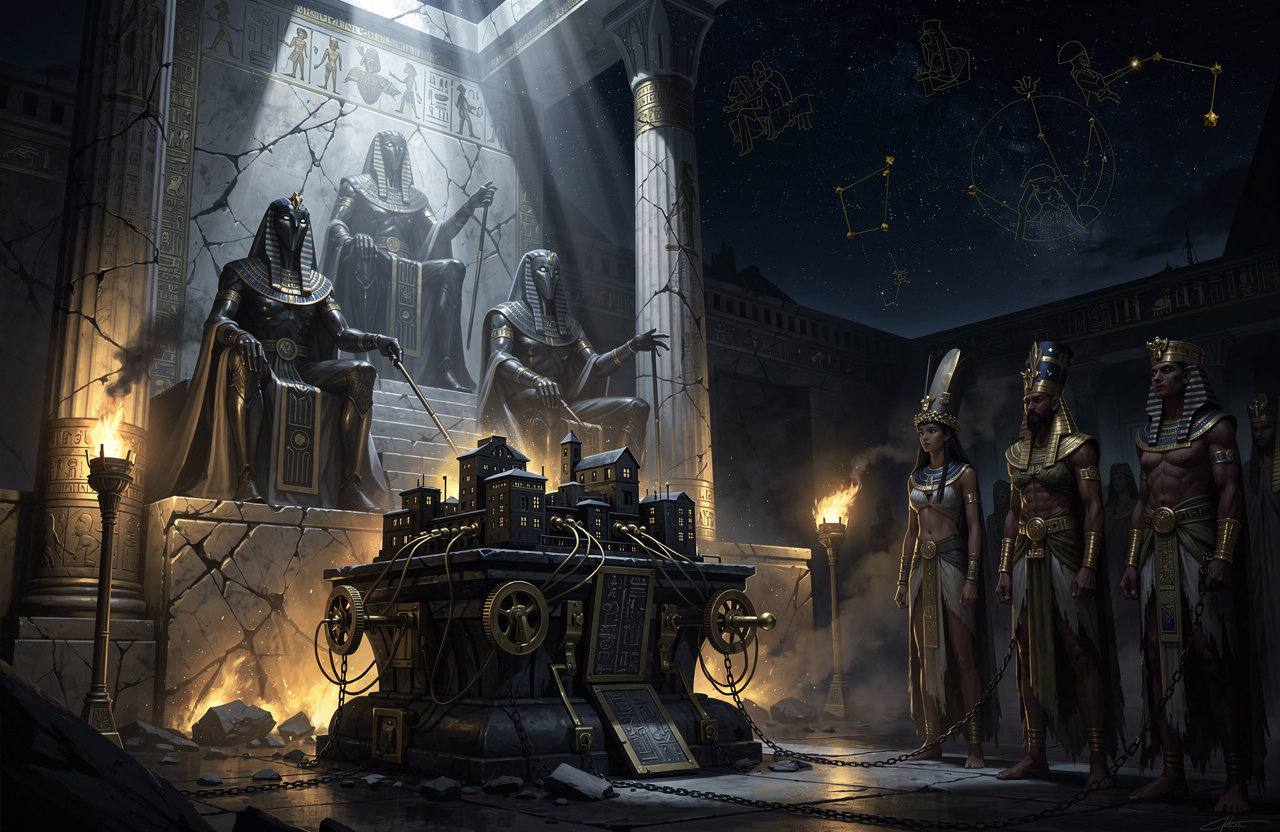
In 2010 Greece had a debt crisis. It sounds like a dry economic headline. In reality it was the public execution of an entire country — a demonstration flogging in front of all Europe, so that other governments would be afraid even to think about independence. And the most striking part: by the end of the story, decisions for the Greek state were no longer being made by the Greek state. They were made by three acronyms with not a single voter in Greece.
Where the debt came from
Let's honestly separate fact from the convenient fairy tale. The fairy tale: "lazy Greeks lived beyond their means and got what they deserved." The fact is more interesting. To get into the eurozone at all, Greece had to show debt within the limit. And it was helped to hide it.
Goldman Sachs ran deals for Greece that let it conceal the real size of its debt — and was paid around 300 million dollars in fees for it. So one of the world's largest banks first helped mask the problem so the country could join the club. And when the deception surfaced and Greece began to sink, the same bank earned again — betting against it, on its collapse. Create the problem, earn on the creation, earn on the "solution." Three times off one victim. The book calls it a triple profit exploit — three withdrawals from a single vulnerability.
Enter the "troika"
When Greece hit bottom, the "troika" took the stage: the European Central Bank, the IMF, and the European Commission. They gave a loan — around 110 billion euros in the first round. But, as always, not "just money." Attached was a list of conditions, and this is where economics ends and politics begins.
The conditions included:
- privatizing key infrastructure — ports, airports, railways, water;
- cutting pensions — in places by nearly half;
- slashing public-sector wages;
- raising the retirement age.
Formally this is a "rescue program." In substance, external administration. The country's budget was now drawn up with an eye on people no one in Greece had elected or could vote out. Democracy, born in these very lands two and a half thousand years ago, was left suspended: vote all you like, but the levers are outside.
A fire sale in the middle of the fire
What happened to the assets shows in the numbers. Out of a planned 50 billion euros from privatization, Greece raised about 2.6 billion — roughly five percent of the plan. Why so little? Because they were selling in a crisis, and the buyer knows perfectly well the seller is desperate. That is how a fence for stolen goods operates.
The Port of Piraeus, regional airports (some went to Germany's Fraport), pieces of the railways and power grids — all sold at clearance prices. And if you trace the ownership chains of the new masters, on the upper floors you find large international infrastructure funds whose main shareholders are the same small group of structures. Greece's common property flowed up the pyramid.
The referendum that changed nothing
Here is an episode worth remembering for anyone who believes voting by itself decides anything. In 2015 the Greeks held a referendum on the creditors' terms. 61% voted against. The people said "no" clearly and loudly.
The government accepted the terms anyway. Because in parallel with the vote the banks were frozen, liquidity was cut off, and the choice came down to something simple: either you comply, or `rm -rf /economy` — the demolition of the country's entire financial system in a matter of days. The will of 61% of voters ran into a lever held not in Athens. The vote existed. The power behind that vote did not.
What was left to the Greeks
The result is cold. Unemployment reached 27%, among youth up to 60%. Pensions were cut by about 40%. Suicides rose. A whole generation of the young left to work in Germany and England. The economy shrank by about a quarter. And the debt, for the sake of escaping which the whole thing was launched, didn't fall — it grew from 120% of GDP in 2010 to 180% by 2015. The rescue increased the debt. A loan to pay a loan.
The historical window for independent development is closed for generations. That is the demonstration scenario: a country in a debt pit isn't pulled out — it's eaten in full view of everyone else, so the others won't get ideas.
Where is the ordinary Greek in this
Everywhere. It is his pension, his job, his children who left, his port sold over his head. And at the same time nowhere: his referendum vote was collected, heard — and ignored, because the real levers weren't in his hands. The same trouble as a fund's shareholder: technically your vote exists, but an intermediary wields it.
The answer: the MAAT token and DAO
The Greek lesson is harsh and precise: voting is not enough if the levers are in someone else's hands. 61% said "no" — and it changed nothing, because the people had neither a shared treasury nor an instrument the creditors couldn't freeze with a single move.
That is the gap MAAT fills. The MAAT token is not just a vote but a stake in a shared, transparent treasury that can't be switched off from someone else's office. The principle is one human, one vote, not "one dollar, one vote." Governance runs through a DAO, a decentralized organization where the treasury is visible to all and doesn't depend on whether someone freezes the local banks. When millions of people from different countries hold a shared token and shared funds, their "no" stops being a slip of paper that can be ignored. The entry is simple: read the book, take the token, get your vote — and make sure that, at last, there is power behind your "no."