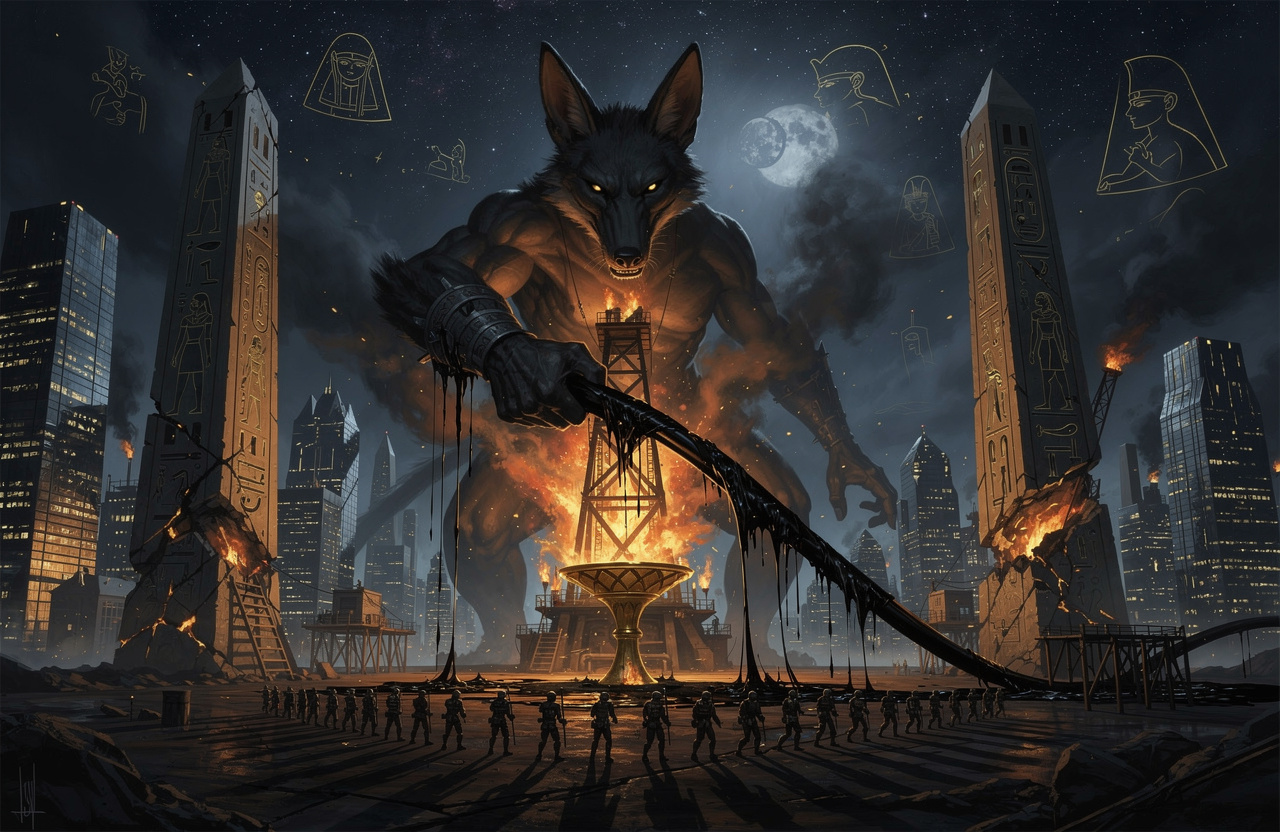
In March 2003 the United States and its allies invaded Iraq. The official reason was stated clearly: Saddam Hussein's regime had weapons of mass destruction, and that was a deadly threat to the world. Under this banner a war began that cost hundreds of thousands of lives and trillions of dollars.
The weapons of mass destruction were never found. They were not there. This is not a skeptic's version — it is an officially acknowledged fact, confirmed by America's own investigations. And when the stated reason for a war turns out to be false, an honest question remains: what were the real reasons? Money, as usual, answers it better than declarations do.
Contracts without a tender
Let's start with the most tangible thing. A war has to be serviced: fuel, logistics, food for the troops, rebuilding infrastructure, putting out oil fires, maintaining bases. That is tens of billions of dollars in orders. A huge share of it went to the company Halliburton and its subsidiary KBR.
The detail that explains everything: a large part of these contracts were awarded without open bidding — under a scheme where the order goes to a specific contractor without a tender, "because only it can do the job urgently." And now the cherry: the U.S. vice president at the time was Dick Cheney — a man who, shortly before entering the White House, had headed that very Halliburton. Formally he had stepped away from the company. But it is hard to imagine a clearer illustration of the chain "politics → military order → corporation."
This is exactly what Eisenhower warned about in the previous article. The military-industrial complex in action: the decision to go to war is made by people closely tied to those who profit from the war.
The dollar underside
But the Halliburton contracts are the visible, "household" layer. There is a deeper layer, a monetary one, and it matters more.
In 2000 Iraq did something that, in the dollar world, is treated almost as heresy: it began selling its oil not for dollars but for euros. It sounds like an accounting trifle. In fact it is a blow to the foundation. World oil traditionally trades in dollars — that is the "petrodollar." Precisely because every country needs oil, every country needs dollars, and so the dollar holds as the world currency. Let a major oil exporter detach from the dollar, and a crack appears in the foundation — one that others may follow.
After the 2003 invasion, Iraqi oil was returned to trading in dollars. A coincidence? Perhaps. But it is a coincidence that fits the logic perfectly: a system does not love those who threaten the petrodollar. And we will see (in the stories of Libya and Gaddafi) that this is not an isolated case but a recognizable pattern.
Where fact ends and myth begins
Let's draw the line honestly, because there is more myth around Iraq than sand. Myth: "The Iraq war was staged solely so Cheney could enrich Halliburton," or "it was all only because of euros for oil." That reduces an enormous event to a single cause. The war also had geopolitics, intelligence-service inertia, real miscalculations, the "export of democracy" ideology, and a revenge for September 11 aimed at the wrong address.
Fact: the stated reason (WMD) was false; Halliburton/KBR genuinely received gigantic contracts, a large share without bidding; the vice president genuinely came from Halliburton; Iraq genuinely moved away from the dollar before the war and returned to it after. Each of these facts is verifiable from official sources.
And here is the conclusion that holds it together. You do not have to pick "the one real reason." It is enough to see that a war begun under a false pretext conveniently coincided with several money interests at once: contractors profited, and a threat to the petrodollar was removed. When the stated reason turns out fake while the financial outcomes are real, the accountant draws conclusions faster than the political scientist.
The price paid by others
This war had a price tag, and the contractors did not pay it. Hundreds of thousands of Iraqis dead. Thousands of soldiers dead. A region destabilized for decades, out of whose chaos new conflicts would later grow. And trillions of dollars added to U.S. sovereign debt — that is, to the future taxes of ordinary Americans. The profit went to a narrow circle. The bill came to everyone else.
This is the very mechanic from the article on debt: war creates debt, debt feeds the financial layer, and the whole thing is paid for by the person who was never even asked.
Where is the ordinary person
Nowhere at the moment of decision — and everywhere at the moment of payment. Was the Iraqi asked? No, the war rolled over him. Was the American taxpayer asked? He was shown a vial of "evidence" that did not exist. Was the soldier asked? He was given an order. The vote belonged only to those who profited from this war.
The answer: the MAAT token and DAO
The Iraq war is possible because the decision, the profit and the reckoning are spread across different people, and the link between them is hidden: some decide, others profit, others pay and die — and all of it is opaque. The counterweight is transparency and a vote for those who pay the bill.
That is MAAT. The MAAT token is membership in a cooperative and a single vote, on the principle one human, one vote — not "whoever's corporation gets the no-bid contract decides." Governance runs through a DAO, a decentralized organization with a transparent treasury where every movement of funds is visible to all, and where no one can quietly lead a country into war on a false pretext while a narrow circle signs contracts. We cannot bring back the dead. But we can build a structure where, between "we decided" and "we profited," you can no longer hide "and you paid." The entry is simple: read the book, take the token, get your vote.