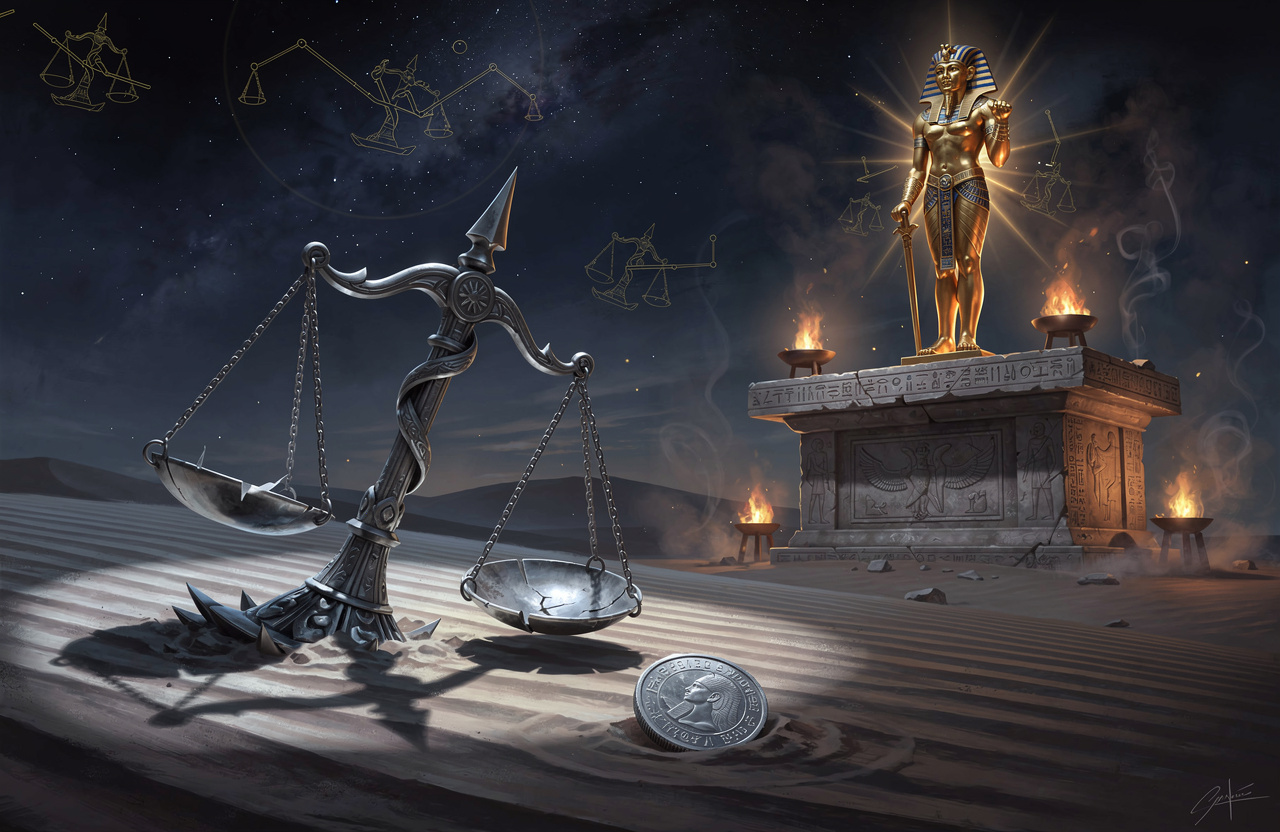
Today's dollar system had a rival. In 1944, when the postwar financial world was being designed at Bretton Woods, two different plans were laid on the table. One won and became the world we live in: the dollar as global anchor, the IMF, the World Bank, debts and interest. The other lost and was nearly forgotten. And yet it was the smarter one. It was conceived by John Maynard Keynes, and the currency in it had a fine name — the "bancor." This is the story of a fork in the road where humanity turned the wrong way. And it's worth understanding, because the fork hasn't gone anywhere.
What's wrong with ordinary money between countries
First, in plain words, the problem Keynes was trying to solve.
When countries trade, some run a surplus (they sell more than they buy and pile up foreign currency), and others run a deficit (they buy more than they sell and slide into debt). In the ordinary system, all the pressure falls on the debtor: he's the one who must tighten his belt, devalue his currency, take IMF loans, and pay interest. The creditor hoarding a surplus does nothing wrong — he's just "doing well, he earned it."
That's where the distortion is buried. A trade imbalance is created by two parties — the one who buys too much and the one who hoards too much and won't put the money back into circulation. But only one is punished. The debtor is always at fault, the creditor always right. Recognize the principle? It's the same logic the whole debt world is built on: all the pressure goes down, onto whoever owes.
What Keynes proposed
Keynes designed a construction as elegant as a good engineering protocol. It was called the International Clearing Union, and its unit of account was the bancor — a supranational currency used only by states among themselves for mutual settlement. Not the dollar, not the pound, not gold in someone's vault — a neutral unit belonging to no country.
And the key brilliant detail: in Keynes's system the pressure was symmetric. Pile up too large a surplus, and your excess is charged negative interest — it gradually melts away. That is, the creditor sitting on money and not putting it to work is fined just like the debtor. The logic is simple and fair: an imbalance harms both sides, so both are obliged to correct it.
This automatically pushed the world toward equilibrium. A surplus country found it profitable to spend and invest its excess — otherwise it would drain away. A deficit country was helped to climb out rather than drowned in debt. By design, money did not stagnate at the top but flowed back into circulation. An engineer would call it a self-regulating system with feedback in both directions, with no single point that accumulates all the power.
Why it was rejected
The answer is painfully simple. Two main players sat at that meeting: a tired, war-ruined Britain (for whom Keynes spoke) and the United States — the world's chief creditor, holder of nearly all the gold and industrial might.
Keynes's symmetric system would have fined precisely the large creditor for hoarding. And the large creditor was exactly the US. Why would the strongest player agree to rules that limit his strength? The American delegation had its own plan (authored by Harry Dexter White): make the dollar the world anchor, peg it to gold, and peg every other currency to the dollar. No fines for the creditor. All pressure on the debtors, as before.
The strong man's plan won, of course. The bancor was rejected. The world got a dollar system with no built-in mechanism to correct imbalances, but plenty of built-in mechanism to keep debtors on the hook. The fork was passed.
Honestly, on fact and myth. The myth: "Keynes was a secret saint who alone knew the truth." The fact: Keynes was also defending Britain's interests, and his plan was no utopia of goodness. But as an engineering construction it was fairer: it spread responsibility onto both sides of the exchange instead of dumping it on the weak. It was rejected not because it was bad, but because it was disadvantageous to the strongest at the table.
Where the ordinary person is in this
In the very world that grew out of the losing fork. Every time "market pressure" dictates that your country cut spending because it runs a deficit, that's an echo of 1944. The pressure always goes down, onto the debtor. A mechanism that would force the hoarder to share too simply doesn't exist in the system — it was thrown out along with the bancor. You live inside the version of the world the strongest chose, not the one that was fairer.
The answer: the MAAT token and DAO
The central lesson of the bancor: a fair system can be designed — Keynes proved it on paper. It is rejected not because it doesn't work, but because it's disadvantageous to whoever holds the power to decide. As long as the strongest player writes the rules, symmetry always loses to asymmetry.
MAAT is an attempt to take that fork again, but in a way where the rules are written not by the strongest at the table, but by the community. The MAAT token is membership in a cooperative where the rule is one human, one vote, not "whoever has more money writes the charter." The treasury is transparent and visible in the DAO — a decentralized organization where power cannot quietly accumulate in one node, because the very design, like Keynes's, won't let it stagnate at the top.
The bancor was rejected because there was no one to defend it but a single weakened country. MAAT's defenders number in the millions, each with one vote. The entry is simple: read the book, take the token, get the vote — and be, for once, among those who write the rules rather than those they're written for.