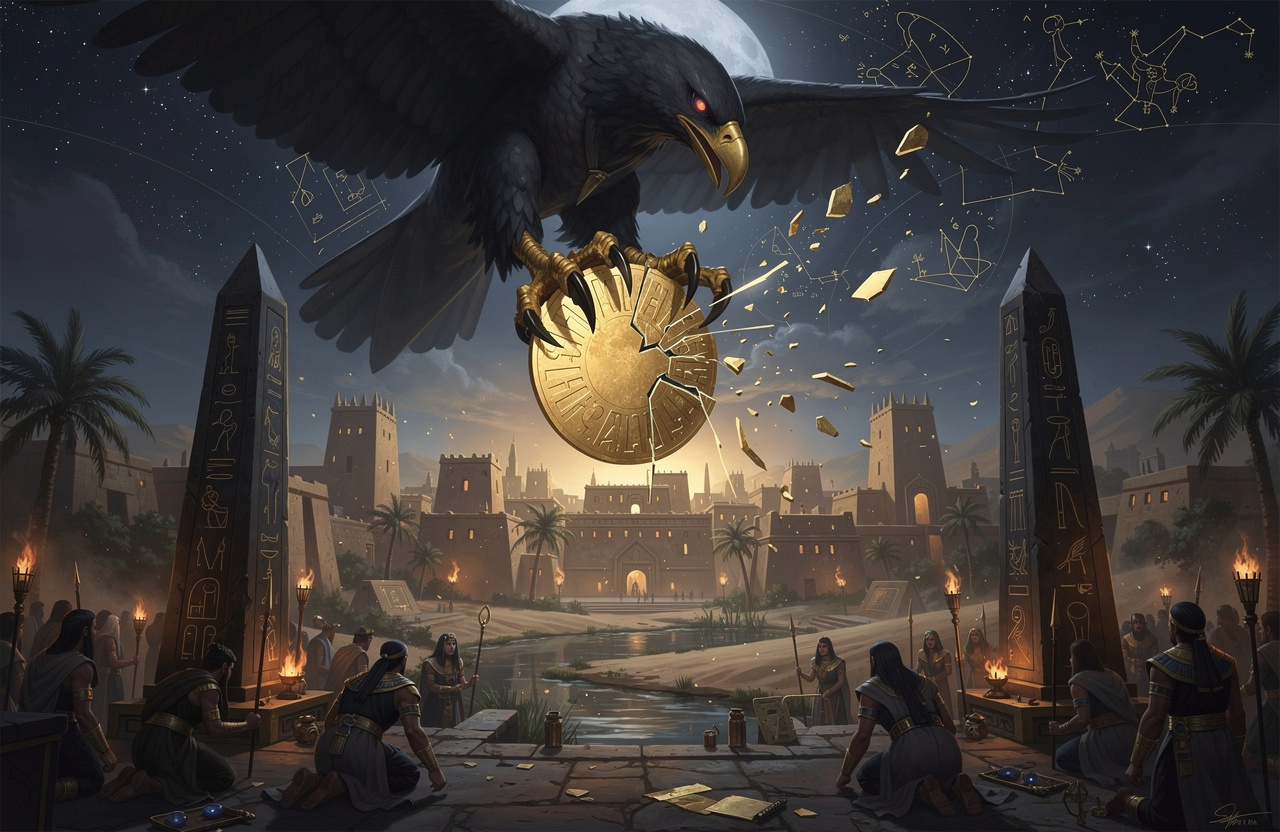
In 2011 Libya was torn apart. NATO airstrikes, civil war, and in October the death of Muammar Gaddafi, the man who had ruled the country for more than forty years. Officially it was a humanitarian operation: protect civilians from a dictator about to commit a massacre. Under that banner a state was destroyed.
And now a strange detail rarely placed next to the humanitarian slogans. Shortly before this, Gaddafi had been promoting an idea capable of redrawing the financial map of a whole continent. The gold dinar. And it is this story that deserves a cold, unemotional look — the way we looked at Iraq.
What the gold dinar was
Gaddafi's idea was simple, and that made it dangerous to the existing order. He proposed creating a single African currency backed by gold — the gold dinar. And trading African resources, above all oil, not for dollars or euros, but for this gold currency.
To grasp the scale of the plan, you need the context. Many African countries are still tied to a colonial monetary system — for example the CFA franc, pegged first to the French franc, then to the euro, with reserves historically held under the former metropole's control. So formally independent countries remained economically inside someone else's currency orbit. The gold dinar struck exactly at this: your own currency, backed not by someone else's promise but by metal that cannot be printed.
Libya had something for such a plan: by various estimates, around 140-odd tonnes of gold in reserves. Not empty dreams — there was backing for the idea.
Why this is scarier than an army
Libya's army threatened neither Europe nor the United States. But the gold dinar threatened something more important than armies — the very logic on which the dollar-euro system rests in Africa.
If resources start selling for gold, demand for dollars and euros for those deals falls. If other African exporters follow Libya, a whole continent's peg to the old currencies cracks. And a gold-backed currency is altogether inconvenient for those used to issuing money out of nothing: you cannot print more gold by a decision in one office. The gold dinar is, in essence, an exit from the system where you are obliged to hold someone else's currency in order to trade your own raw materials.
An engineer would say: Gaddafi was proposing to fork the continent's financial system and launch an alternative protocol incompatible with the old one. And the owners of the old protocol dislike such forks intensely.
What came out later
The most interesting part surfaced later. In the correspondence of then U.S. Secretary of State Hillary Clinton, which became public, the motives for intervention in Libya explicitly mentioned Libyan gold and Gaddafi's plans for a pan-African currency — as a factor threatening French influence and financial interests in the region. So "protecting civilians" was not the only thing on the table. Gold and a currency project were on the table too.
In the book this project stands on, Libya 2011 sits in a row with other leaders removed for trying to exit the debt/dollar logic: "Gaddafi (Libya, 2011) — gold dinar, destroyed." It is the same pattern the economic hitman John Perkins described: when a leader says "no" to the system and tries to control his country's resources his own way — it is not negotiators who arrive.
Where fact ends and myth begins
Let's draw the line honestly. Myth: "Gaddafi was a saint dreaming only of Africa's good, and the West killed him solely over gold." Gaddafi was no saint: an authoritarian ruler with his own list of victims and whims, and the Libyan conflict had real internal causes and real violence. Reducing everything to gold alone is a simplification.
Fact: the gold dinar and pan-African currency project genuinely existed; Libya genuinely had large gold reserves; these motives genuinely appeared in Western officials' correspondence alongside the humanitarian ones; and the outcome — a destroyed state and a killed leader — fits exactly the pattern "exited the system — eliminated." This is verifiable.
And the conclusion is the same as with Iraq: you do not have to pick a single cause. It is enough to see that, under the humanitarian flag, the removal of a threat to the dollar-euro system coincided very conveniently. When the slogan is humanitarian but the result is a removed financial threat, the accountant again draws conclusions faster than the political scientist.
Where is the ordinary person
The Libyan of 2011 got not freedom but a collapsed state, years of chaos, slave markets on the coast and a flood of refugees. The African dreaming of a currency independent of the former metropole was left with the old system. And the European and the American sold the "humanitarian operation" paid for it in taxes and got a new crisis on their southern borders. The vote, as always, did not belong to those it concerned.
The answer: the MAAT token and DAO
The story of the gold dinar is a story that exiting someone else's financial system alone — even as an entire state with gold in the vaults — is deadly dangerous: a lone node challenging the network is vulnerable. The conclusion is not to stop trying. The conclusion is that you must exit not alone and not from the top, but as a multitude, from below, and transparently.
That is MAAT. The MAAT token is membership in a cooperative and a single vote, on the principle one human, one vote — not "whoever has the gold and the power dictates the currency." Governance runs through a DAO, a decentralized organization with a transparent treasury that cannot be bombed like a single palace and cannot be eliminated by removing a single leader. Gaddafi tried to build an alternative as one man at the top — and became one target. A network of millions of token holders does not become a target so easily. The entry is simple: read the book, take the token, get your vote.