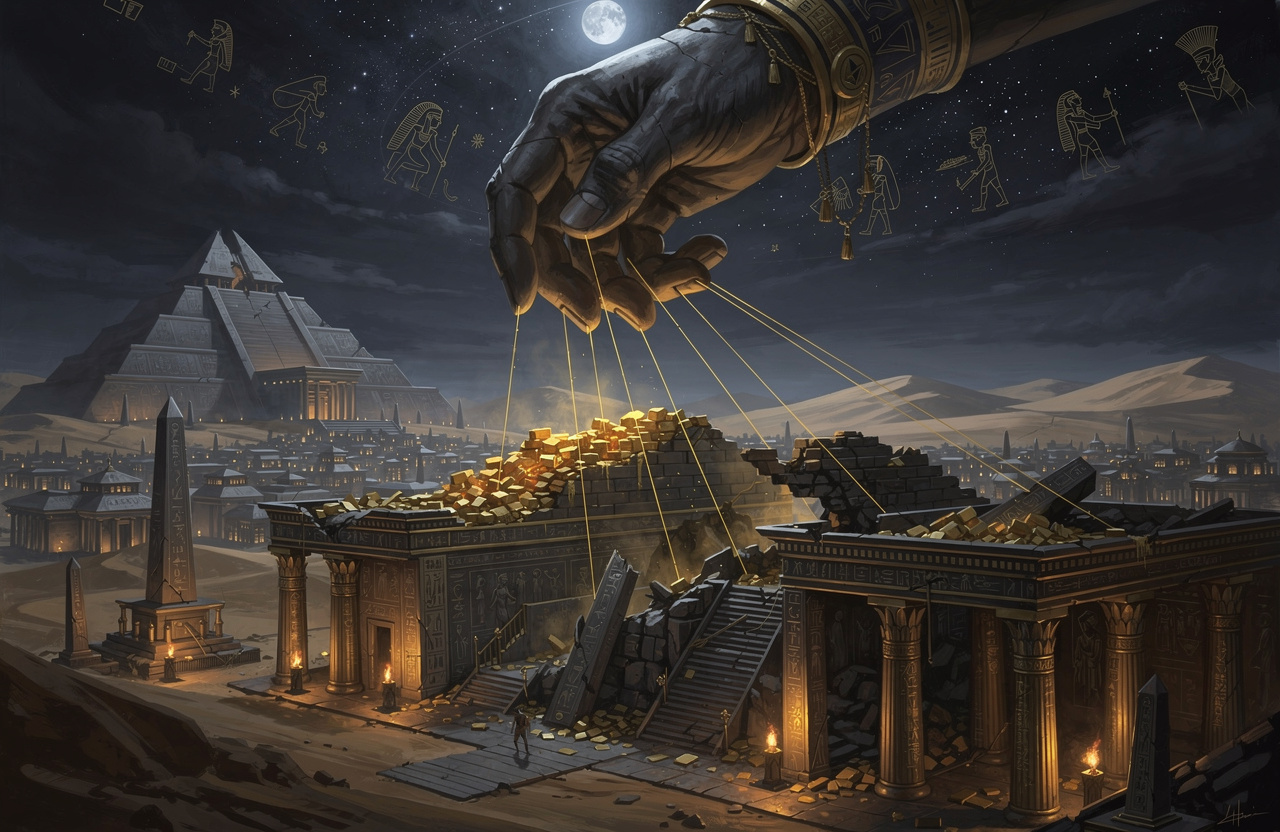
Some stories are told as a fairy tale about a kind giant. The Marshall Plan is one of them. The textbook version goes like this: after the Second World War, America out of the goodness of its heart poured billions of dollars into a ruined Europe, and on that money Europe rose from the rubble. Gratitude, friendship, shared values. End of film.
All of this is true. And all of this is only the top layer. Because generosity in finance always has a structure, and if you look at the structure of the Marshall Plan, you see something more interesting than kindness.
What it actually was
From 1948 to 1952 the United States sent Western Europe around 13 billion dollars (an enormous sum in the money of the time) under the European Recovery Program, which everyone calls by the name of Secretary of State George Marshall. The money went to rebuilding industry and infrastructure, and to buying raw materials, fuel, equipment and food.
The effect was real: Western Europe genuinely recovered faster than it could have otherwise. Hunger receded, factories started up. There is nothing to argue with here. The question is not whether the Marshall Plan helped — it did. The question is how exactly that money was structured, and who in the end benefited most.
Money that came back home
The first subtlety: a large share of the aid was "tied." That means Europe had to use the dollars it received to buy goods from American producers. The logic is simple and, for the U.S., flawless: the money was issued in Washington but spent mostly in American factories. So it was not only help for Europe — it was also a demand boost for America's own industry, which had ramped up capacity during the war and needed markets.
An engineer would call it clever system design: you give the user "free credit," but it can only be spent in your own store. The money makes a loop and returns to where it came from, leaving you with both a grateful customer and a sold product.
The dollar as Europe's operating system
The second, deeper subtlety. The Marshall Plan built the dollar into the very foundation of postwar European economics. Before the war, the world counted largely in pounds and gold. After it, Europe rebuilt on dollars, traded in dollars, held reserves in dollars. This fit perfectly with the Bretton Woods system, in which the dollar became the anchor world currency.
From that point the dollar was not just a foreign currency for Europe. It was, in effect, the operating system on which the whole economy ran. And whoever writes the rules of that OS holds the kill switch: the interest rate, the money supply, access to dollar liquidity. Europe got its recovery — and at the same time became dependent on a monetary system governed not in Europe.
Where fact ends and myth begins
Let's draw the line honestly, so as not to fall into cheap anti-Americanism. Myth: "The Marshall Plan was a cunning trap to enslave Europe, and the recovery was a deception." No. The recovery was real, the money was real, millions of people genuinely lived better. To call this a "deception" is to lie.
Fact: at the same time, the Marshall Plan was not pure charity but a highly profitable investment for the U.S. with a double bottom: it simultaneously boosted demand for American industry, tied European markets to American goods, and cemented the dollar as the basis of Europe's financial system. Aid and strategic interest do not contradict each other here — they coincided. That is precisely why the plan worked so smoothly.
And this is the whole subtlety of Isfet at the level of states. You do not have to rob. You can give — but in such a way that the giver comes out stronger after the handout, and the receiver comes out more dependent. Help after which you owe. Not directly in money, but in structure, currency, markets.
Debt does not always look like debt
The most important thing in this story is that dependency need not look like bondage. Europe signed no shameful papers; no one held a gun. It is simply that after the Marshall Plan, the European economy was tuned so that its prosperity depends on someone else's currency and someone else's markets. This is debt of a new kind — not a line in a contract, but a built-in architecture of dependency. The sturdiest debt is the one the debtor does not even perceive as debt.
Where is the ordinary person
Strangely enough, ahead — over the short run. The European of the Marshall Plan genuinely got better off: work, food, a rebuilt home. But over the long game he entered, without knowing it, a system in which the key levers of his well-being are not in his hands, nor even in his country's. While the system grows, all is well. When the kill switch is turned up top, it becomes clear whose OS it was all along.
The answer: the MAAT token and DAO
The lesson of the Marshall Plan is not that aid is bad. It is that aid framed as dependency on someone else's centralized system leaves the levers up top. The counterweight is infrastructure that belongs to no one personally and whose rules are transparent and not rewritten in a single office.
That is MAAT. The MAAT token is membership in a cooperative and a single vote, on the principle one human, one vote — not "the rules are written by whoever's currency became your operating system." Governance runs through a DAO, a decentralized organization with a transparent treasury and open rules, visible to all and independent of a kill switch in someone else's capital. Real help is not the kind after which you owe, but the kind after which you have become more self-reliant. The entry is simple: read the book, take the token, get your vote.