When an engineer designs a system that must never go down, he doesn't run it on a single server. He spreads the load across several nodes in different data centers, so that a fire in one building can't take everything offline. We call this fault tolerance. It sounds like 21st-century technology. In fact, the first such architecture for money was built by a coin dealer from the Frankfurt ghetto in the second half of the 18th century. His name was Mayer Amschel Rothschild, and he had never heard the word "server" — yet he intuitively did exactly what we now call a distributed network.
The man from the alley
Mayer Amschel was born around 1744 in the Jewish quarter of Frankfurt — on a street literally called Judengasse, "Jews' Alley." This was no metaphor for a ghetto; it was an actual one, with gates locked at night and limits on professions, movement, and even on how many Jewish marriages were permitted per year.
He started small: changing coins, dealing in old and rare medals. Numismatics is what brought him close to nobility — he became a coin supplier to the collection of the Landgrave of Hesse-Kassel, one of the richest princes in Europe. Through that door, Mayer Amschel reached the place where the truly large money moved: the management of princely capital and state loans.
Notice that his starting capital was not financial but reputational. He became a node that others trusted. In network terms, he earned a trusted connection into a place that had previously kept him out.
An idea that looked foolish
By the end of the century, Mayer Amschel had five sons: Amschel, Salomon, Nathan, Carl, and James. Any sensible merchant of the era would have kept the business in one city and handed it to the eldest son. Concentration, control, everything within reach.
Mayer Amschel did the opposite. He sent his sons to five capitals: Amschel stayed in Frankfurt, Nathan went to London, James to Paris, Salomon to Vienna, Carl to Naples. From the outside it looked like scattering his strength. In reality it was engineering.
Five banks in five cities operated neither as five competitors nor as five branches under one boss. They worked as nodes of a single network: shared correspondence, split risk, insured one another, and instantly moved capital to wherever it was most needed or safest. If one node had a problem, the others absorbed it. That is fault tolerance — a century and a half before the first computer.
Five arrows
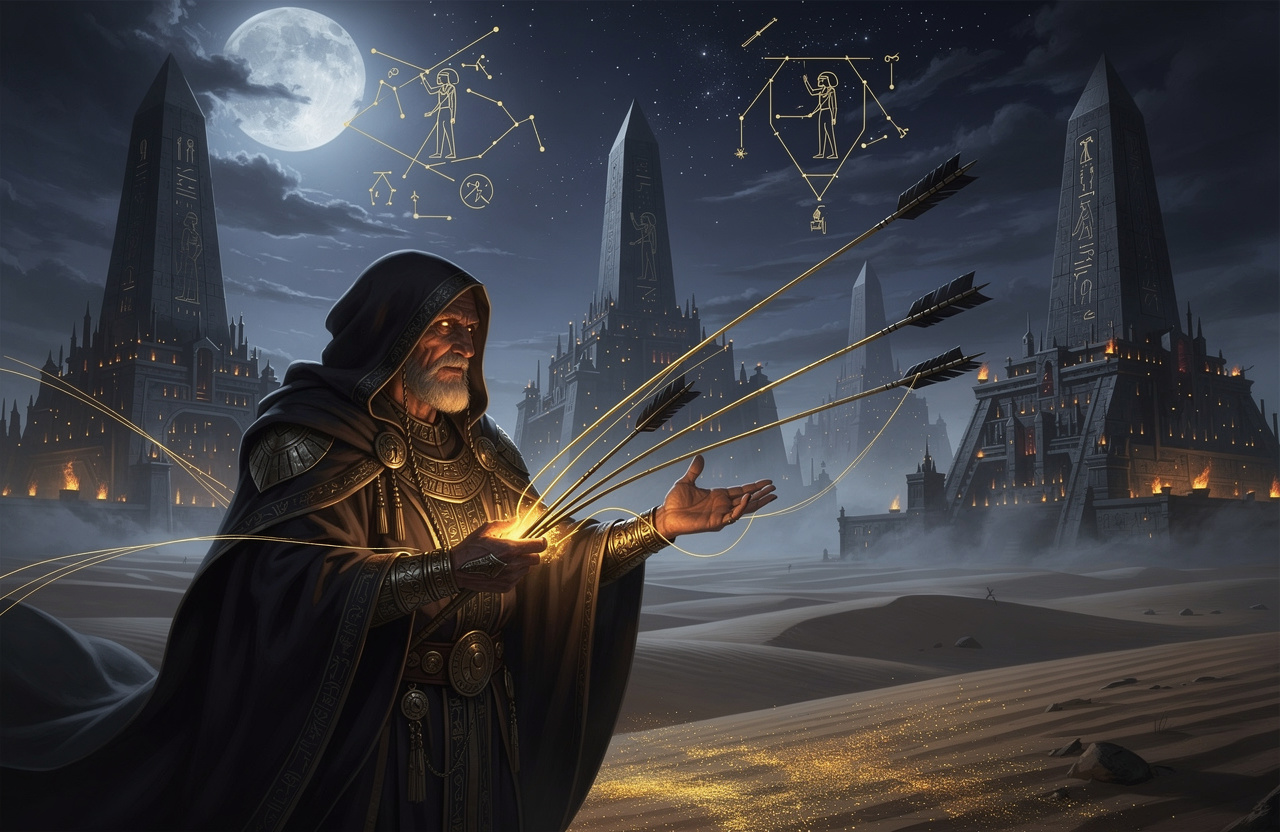
The family crest fixed the idea in a symbol: a hand gripping five arrows. The message needs no translation. One arrow snaps easily. Five, bound together, are almost impossible to break.
This is not just elegant heraldry. It is an engineering principle expressed as a picture. The strength is not in any single arrow — the arrows are ordinary. The strength is that they are bound together. Remove the binding and you have five lone twigs, broken one at a time. Keep the binding and you have a structure that resists a force capable of breaking any single element.
That distinction — between "a sum of loners" and "a connected network" — is exactly what most people fail to feel. And the entire history of capital rests on it.
Why the network outlasted borders
In the 18th and 19th centuries, power was tied to a place. A king ruled land, a merchant traded in a town, a court banker served one specific monarch. Everything had a fixed address — and therefore a vulnerability: if the court fell or your king lost a war, you went down with him.
The Rothschild network had no fixed address. When war broke out between countries, the network had nodes on both sides of the front. One lost, the other won, and capital flowed to the safe node faster than armies could march. Money not tied to one country turned out stronger than any single country. It was the first working model of what would later be called supranational capital.
It is worth separating fact from myth honestly. Fact: Mayer Amschel and his sons genuinely built the first cross-border banking network and became enormously influential. Myth: that this implies a "secret world government of one family." Reality is more interesting. Families come and go, but the architecture — five connected nodes instead of five loners — proved immortal. Today that same blueprint runs faceless funds and holdings with not five nodes but thousands, and no family name on the crest.
What we take from this story
Mayer Amschel won not because he was an evil genius. He won because he organized into a network when everyone around him acted alone. It was an engineering victory, not a mystical one.
And right here is where the ordinary person has been losing for three centuries running. He is a single arrow. His savings, his labor, his shareholder vote sitting inside a pension fund — all of it one at a time, scattered, easy to snap individually. Against a connected network, the loner doesn't stand a chance — not because of weak character, but because of architecture.
The answer: the MAAT token and DAO
If the clans' strength is that they are bound into a network and we are not, then the answer must be symmetric: ordinary people need their own network. Not to become the new moneylenders, but to stop being lone twigs broken one by one.
That is the meaning of MAAT. The MAAT token is membership in a cooperative where millions of scattered people bind their votes into a single bundle. But unlike the Frankfurt family, here the principle is one human, one vote, not "whoever has more money decides." Governance runs through a DAO — a decentralized organization with a transparent treasury where every movement of funds is visible to all, and no node can quietly seize what belongs to everyone. Mayer Amschel proved the theorem: a connected network beats loners. We simply turn it around. The entry is simple: read the book, take the token, get your vote — and gather into a bundle that won't snap.