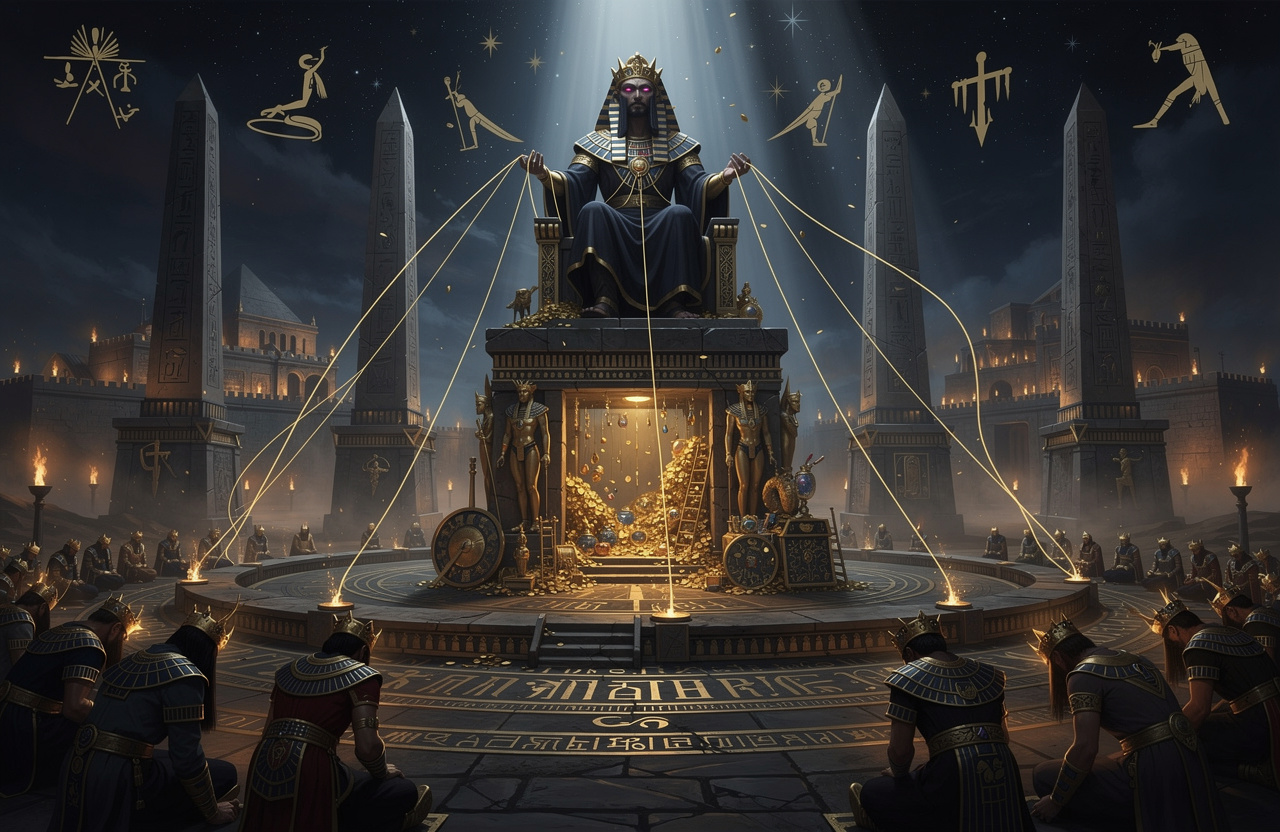
If you want the moment money first became more important than borders, the easiest place to start is one Frankfurt family. Not because the Rothschilds are the world's chief villains — that is mythology by now — but because they were the first to build what an engineer would call a distributed network. And that architecture outlived them by two hundred years.
Five arrows
Mayer Amschel Rothschild started in the Frankfurt ghetto, changing coins and dealing in rare medals. By the end of the 18th century he had five sons. Instead of keeping the business in one city — sensible for a shopkeeper — he did something unusual. He sent his sons to five European capitals: Frankfurt, London, Paris, Vienna, Naples.
Each son opened a bank in his city. But these were not five separate banks — they were one bank with five nodes. They shared correspondence, split risk, insured one another, and moved capital between countries at moments when any single country might collapse while the network would not.
The family crest is a hand gripping five arrows. The message is simple: one arrow snaps, five do not. This is, if you like, the first fault-tolerant architecture of capital in history. One node falls, the system keeps running.
Why the network beat the crown
In the 18th and 19th centuries, power and money were still tied to a place. A king ruled land. A merchant traded in a town. A banker sat at the court of one specific monarch. Everything had a fixed address.
The Rothschilds were the first to grasp that capital not tied to one country is stronger than any country. When two states go to war, an ordinary banker on the losing side loses everything. But a network with nodes on both sides of the front profits either way. Money flows to wherever is safer, faster than any army.
The famous Waterloo story — heavily embroidered by legend — is exactly about this: whoever has information first and can move the bet instantly wins not on the battlefield but on the gap in time. It didn't matter who won. It mattered that the network knew first.
What they actually invented
Not the "world government" of conspiracy pamphlets. Something far more real and important: supranational capital — money that stands above states because it depends on none of them.
Everything grew from that idea. International bonds. Private houses financing governments. The principle of lending to countries and living off the interest. The habit of elites coordinating across borders while staying public competitors. Today's transnational funds are the same five-arrow architecture, only now there are thousands of nodes, and they no longer go by a family name.
Where fact ends and myth begins
Let's draw the line honestly. Fact: the Rothschilds genuinely built the first cross-border banking network, financed governments and wars, and were enormously rich. Myth: that they still secretly rule the world from a basement, pulling every string.
Reality is duller and more frightening at once. There is no single basement. There is a principle they perfected, one stronger than any family: capital organized as a network and placed above states will always beat scattered individuals. Today that principle is embodied not by the Rothschilds but by faceless structures — funds, holdings, cross-ownership. The name changed; the architecture stayed.
The lesson we take for ourselves
The most interesting thing about the Rothschild story is not the wealth but the engineering idea. They won not because they were evil geniuses, but because they organized into a network when everyone else acted alone. Five arrows against single twigs.
And that is exactly where the ordinary person has been losing for two hundred years. He was always a single arrow. His savings, his vote, his labor — one at a time, scattered, easy to snap.
The answer: the MAAT token and DAO
If the clans' strength is that they are networked and we are not, then the answer is obvious and symmetric: ordinary people need their own network. Not to become the new moneylenders, but to stop being lonely arrows.
That is the meaning of MAAT. The MAAT token is membership in a cooperative where millions of scattered people gather their votes into a single bundle. Only, unlike the old banking houses, here the principle is one human, one vote, not "whoever has more money decides." Governance runs through a DAO — a decentralized organization with a transparent treasury where every movement of funds is visible to all, and no node can quietly seize what belongs to everyone.
Two hundred years ago the Rothschilds proved a theorem: the network beats the loners. We are simply turning that theorem around — in favor of those who were always the raw material, never the player. The entry is simple: read the book, take the token, get your vote — and stop being an arrow that snaps so easily.