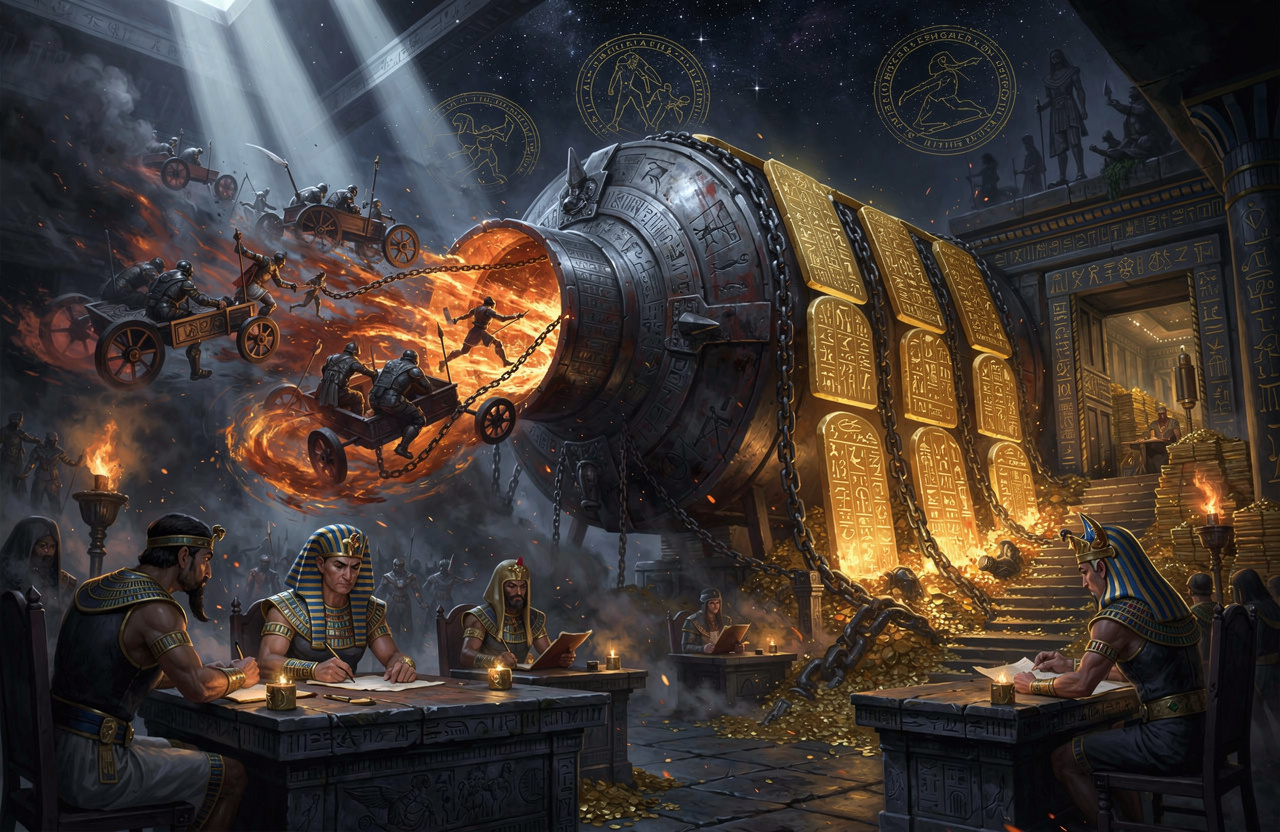
War gets explained to us any way you like: ideology, security, nation, freedom, revenge. Anything except the simplest accountant's question: who pays for this, and who is owed afterward? Because every war has a dull financial underside, and it has not changed in thousands of years. War is the fastest way to turn a state into a debtor. And wherever a debtor appears, a creditor always appears too.
Wars are not paid out of pocket
A simple thing, oddly seldom said aloud: no state pays for a large war out of current revenue. Taxes are not enough, and raising them during a war is politically dangerous. So war is borrowed. The state issues bonds — IOUs — and sells them. They are bought by whoever has spare capital: banks, investment houses, wealthy holders.
And here is the key point. The state will spend that money fast and irreversibly — on shells that will explode, on equipment that will burn, on people who will die. But the IOU remains. With interest. And it will be paid off afterward, for decades, out of the taxes of ordinary people — many of whom were not even born when the guns fired.
An engineer would say: war is an entry in the credit ledger that outlives the war itself by two or three generations. A shell is gone in a second. The debt on it amortizes for a hundred years.
Who sits on this side of the deal
Shells explode and vanish. Bonds do not vanish. They settle with holders and start yielding interest. Whoever lent the state money for the war risks no life at the front — he receives a state-guaranteed stream of payments. The bigger and longer the war, the larger the debt issuance, the larger the interest.
This is the foundation under the whole story of this block. Financing both sides of a conflict (as Sutton showed) is profitable precisely because both sides take on debt. It does not matter who wins on the battlefield — both sides leave the war as debtors, and both will pay interest. Victory and defeat are for soldiers. For the bondholder, there is only the coupon.
Mechanics, not theory
This is not the malice of an individual banker; it is the mechanics of a system. In the book this project stands on, it is described as the economic-hitman algorithm laid out by John Perkins: create debt → make sure the country is driven into an unpayable loan → take the assets and control through "conditions of assistance." War is simply the fastest and most indisputable way to complete the first step. No negotiation drives a country into debt as swiftly as mobilization.
And there is one more, subtle layer. In a dollar world, the creditor holds an extra lever: the debt is denominated in a currency the debtor state does not print. Raise the rate in one office, and the debt of every debtor worldwide automatically grows heavier. No negotiation, no consent. The book names it aptly: remote code execution at the level of a state. War creates debt, and debt turns sovereignty into a manageable parameter.
Where fact ends and myth begins
Let's draw the line honestly. Myth: "Every war in history was invented by bankers sitting in one office and pressing a 'war' button." That is a simplification. Wars also have real causes — territory, fear, rulers' ambition, ethnic conflict, mistakes. Not every war was ordered for the sake of interest.
Fact: at the same time, any large war, whatever its cause, produces sovereign debt on a gigantic scale, and that debt is an asset for whoever holds it. So even a war begun for "sincere" reasons feeds a financial layer that profits from it. You do not have to order a war — it is enough to be ready to finance it and hold the IOU.
And this is why no war ever truly leads to peace. As the book puts it: war is not a means of solving a problem but a means of feeding. The farmer does not slaughter the cow — he milks it every day. The debt is that milking, stretched across generations.
Where is the ordinary person
In the worst possible spot. He pays three times. First in blood, if he goes to the front. Then in a wrecked economy and inflation right now. And finally in taxes for decades to come, servicing the interest on the debt hung on his country. Three payments for one war. The bondholder pays zero and collects the coupon.
The answer: the MAAT token and DAO
The war-as-debt mechanic works because the decision to borrow is made by some, the blood and interest are paid by others, and a third party profits from the IOU — and all of it is opaque. The counterweight is transparency and a vote for those who actually pay.
That is MAAT. The MAAT token is membership in a cooperative and a single vote, on the principle one human, one vote — not "whoever holds the country's IOU decides." Governance runs through a DAO, a decentralized organization with a transparent treasury where every movement of funds is visible to all, and where no one can quietly turn someone else's war into their own coupon income. We will not abolish wars with a single button. But we can build a structure where those who pay can finally see who profits, and on what. The entry is simple: read the book, take the token, get your vote.