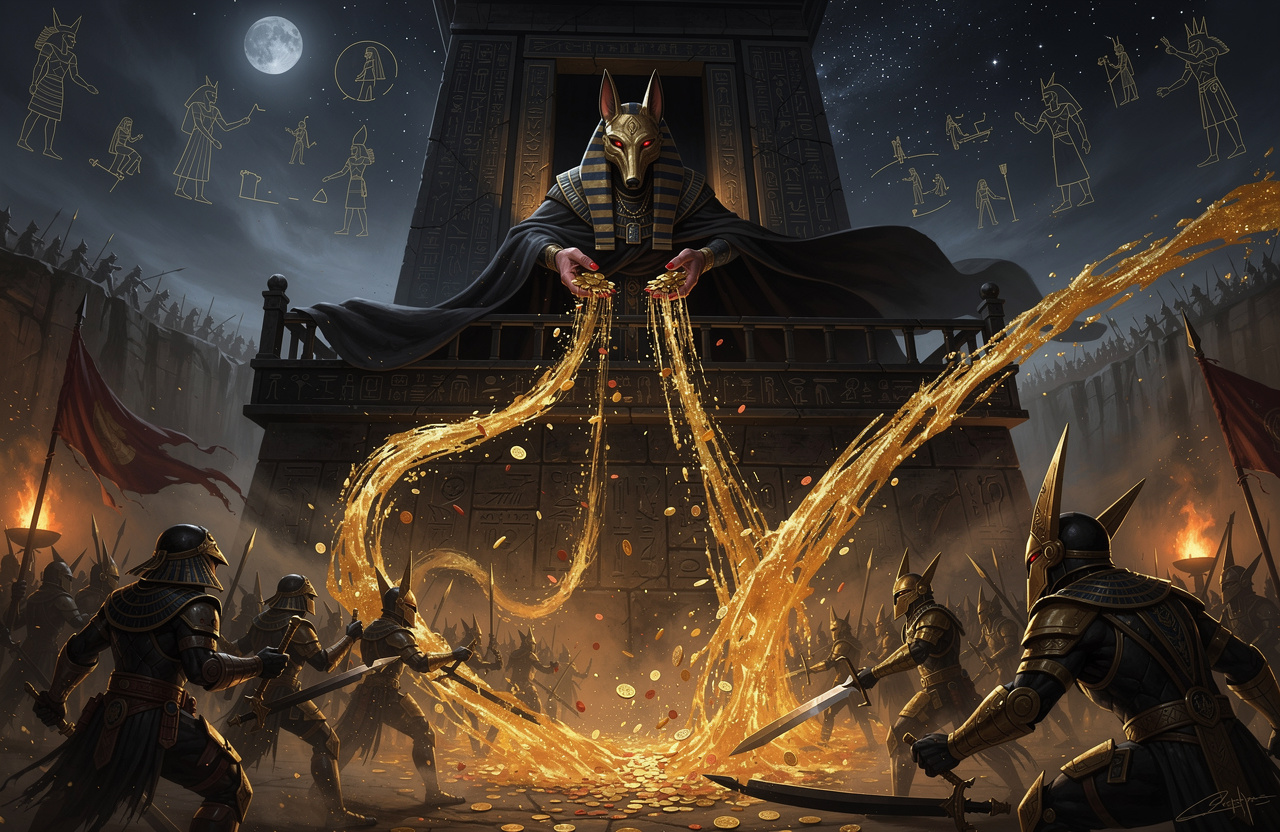
Wars are always explained through ideas: freedom, faith, nation, justice. But every war has a prosaic underside that is rarely discussed. War is, above all, incredibly expensive. Armies, weapons, shells, fuel, payments — all of it costs so much that it is almost never covered out of a state's current income. Which means a country at war does the same thing a person does when he can't afford a big purchase. It borrows.
And here a figure appears who does not shoot, does not die, and wears no uniform, yet almost always wins. The one who lends money at interest. Shells explode and vanish. The debt remains. And the country will keep paying it long after the guns fall silent.
Where a state gets money for war
There are essentially three ways, and all of them end in debt.
- War bonds. The state issues debt paper and sells it to banks, funds, and citizens. You are promised: lend now — we'll return it with interest later. Both world wars were financed this way: the population patriotically bought up war bonds, essentially lending to its own state against future taxes.
- Bank loans. Large financial houses lend directly to governments. This is the oldest business: Italian and German bankers financed kings and then collected interest, concessions, and privileges from them.
- Printing money. When there is no one left to borrow from, they switch on the press. But it isn't free: the population pays through inflation — a hidden tax that dilutes everyone's savings at once.
In all three cases the outcome is the same: after the war a mountain of debt hangs over the country, with interest to be paid. And it is paid out of taxes — that is, out of ordinary people's pockets, generation after generation.
Why it is a perpetual engine for the lender
Look at war through the eyes of the one who lends. For him it is, however cynical it sounds, an excellent market.
First, demand for money in wartime is enormous and inelastic: the state will borrow at almost any rate, because the choice is borrow or lose. Second, war suspends caution: in peacetime a government haggles over terms, in wartime it grabs what is offered. Third, the debt outlives the war. A shell is single-use; a bond works for decades, dutifully dripping coupons.
An engineer would say: the lender attaches to the country's budget like a background process that launches during the war and then never unloads from memory. It sits in the system and quietly consumes the resource — taxes — for decades. The war is over, but the process keeps running.
Hence the cold conclusion: peace is as unprofitable to the one who lives on war-debt interest as the absence of thieves is to a night guard. This does not mean bankers personally start every war. It means there is a powerful node in the system for which war is steady, predictable, very large income. And nodes pull the system toward where they thrive.
Fact and myth
Let's draw the line honestly.
Myth: "All wars are directly arranged by bankers to profit — they sit down and plan them." Too simple. Wars arise from many causes: fears, ambitions, real conflicts, mistakes. The banker is rarely their director.
Fact: but the banker is almost always the beneficiary. Historically, financial houses lent to warring sides — sometimes to both at once — and came out of wars richer than they went in. This is not a conspiracy theory, it is accounting. States went bankrupt, populations were impoverished, and holders of war debt collected their interest. War redistributes: it takes from peoples and adds to creditors.
A structure that extracts income from others' suffering and returns nothing to the system is, in the book's language, Isfet — the inversion of fair exchange. This is not a "cartoon villain banker." It is a position: latch onto the flow and feed while the flow runs. War is the most generous of flows.
Where is the ordinary person
Everywhere it hurts. He goes to the front. He buys war bonds out of patriotism. He loses his savings to the inflation that pays for the war. And after the war, he, his children, and his grandchildren pay taxes for decades, part of which goes to interest on the debt run up for that war. A cruel symmetry results: the ordinary person pays for war four times — in blood, in bonds, in inflation, and in a lifelong tax to service the debt. And the profit from the interest is collected by someone who was never at the front.
And, as always, the decision to plunge into war debt is made without him. He is presented with the fact and sent the bill.
The answer: the MAAT token and DAO
War debt works because the creditors are coordinated and organized while the payers — taxpayers and soldiers — are scattered and voiceless. The first act as a network with a shared interest in collecting interest. The second act as a crowd of loners who are simply handed the bill.
MAAT gathers the loners into a force. The MAAT token is membership in a cooperative and a single vote on the principle of one human, one vote, not "whoever has the capital dictates the loan terms to the whole country." Governance runs through a DAO — a decentralized organization with a transparent treasury where every movement of funds is visible to all. A transparent shared treasury is the direct opposite of the dark mechanics of war debt, where the ordinary person pays but neither sees nor decides. Here you cannot quietly saddle people with interest they were never asked about: the treasury is in plain view, everyone has a vote, and what decides is the number of people, not the size of the wallet. The entry is simple: read the book, take the token, get your vote — and stop being the one who pays for war four times without ever declaring it.