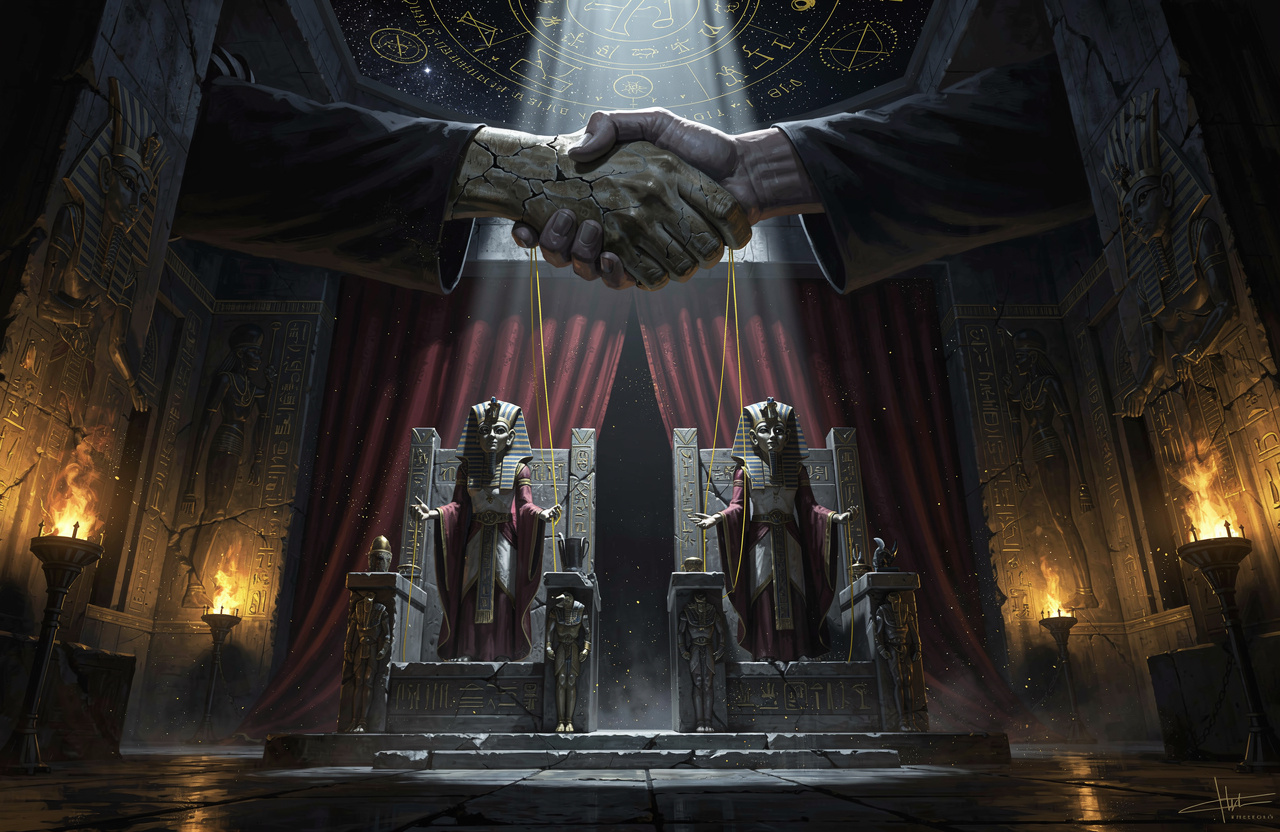
The two most powerful financial institutions on the planet manage the debts of dozens of countries, dictate their terms, and decide who gets money and who doesn't. It's reasonable to ask: who runs these institutions, and how are those people chosen? The answer is disarmingly simple. The head of the IMF is always appointed by Europe. The head of the World Bank, always by the US. Not "usually." Not "as a rule." Always — across the entire history, without a single exception. And nowhere is this written into law. It is a verbal arrangement nearly eighty years old.
What happened in 1944
In the summer of 1944, before the Second World War had even ended, delegations from over forty countries gathered at the resort of Bretton Woods in the US. The war was clearly heading to its conclusion, and the victors were designing the postwar financial world in advance. From that meeting two institutions were born: the International Monetary Fund (IMF) and the International Bank for Reconstruction and Development, which we know as the World Bank.
Formally these were international organizations with many member states. But two chief architects sat at the table: the US (which at the time held nearly all the world's gold and the lion's share of industry) and Britain, whose delegation was led by the economist John Maynard Keynes. The dollar was made the anchor of the system. And leadership of the two new institutions was split between them like gentlemen.
The arrangement — literally called "the gentlemen's agreement" — was simple: the managing director of the IMF would be a European, the president of the World Bank an American. And so it has gone ever since.
A list that never had an exception
Look at any biography of IMF heads — France, Sweden, Germany, Spain, France again, Bulgaria. Always a European. Look at the heads of the World Bank — all Americans, often drawn from the world of high politics, investment banking, and defense departments. Always a US citizen.
In nearly eight decades, not once has an African led the IMF. Not once has an Asian led the World Bank. And yet the countries of Africa, Asia, and Latin America are these institutions' main "clients," their main borrowers, the ones whose fates are decided by their loans. Decided for them — always by people from a narrow circle of two founding regions.
An engineer would say: admin rights are hard-wired into the system, root access was granted to two accounts at install time, and in 80 years the configuration has never been rewritten. Everyone else on the network has a login — but no rights to the key operations.
Why it holds
Here we recall the mechanics of percentages. Decisions in these institutions are made by "weighted" voting — a country's vote is proportional to its financial share. And the largest shares belong to those same founders. Key decisions require a supermajority that cannot be assembled without the leading Western powers' consent.
So formally, any countries can nominate and support a candidate for director. But in reality, the one who gets through is the one the holders of the largest shares have agreed on. And for nearly eight decades they have agreed by the old formula: the IMF for Europe, the Bank for America. Why break a scheme that reliably keeps the wheel in their own hands?
And here we should honestly separate fact from myth. The myth: "a secret committee in a basement personally appoints puppets." The fact is far duller and far sturdier: there is an open voting procedure, a distribution of shares, and an unwritten arrangement under which the procedure yields the same result every time. No basement is needed. Rules written so that it cannot come out otherwise are enough.
What it means for debtor countries
When a country comes to the IMF for a rescue loan, across the table sits a person it did not appoint, nor did countries like it — but a narrow circle of the richest powers did. That person and their staff decide which "conditions" to attach to the money: what to privatize, what to cut, which subsidies to scrap.
So the judge, the creditor, and the author of the rules are on one side of the table. And the borrower, who will live with the consequences, is on the other — and had no say in choosing the judge. This is not "help between equals." It is a structure where the roles are assigned in advance: who decides and who obeys.
Where the ordinary person is in this
Very far from the table and very close to the consequences. You did not choose the head of the IMF or the president of the World Bank — nobody chose them in the usual sense; they were appointed by the 1944 deal. Yet it is their decisions that turn into the tariffs you pay, the pension they cut, the hospital closed "for budget discipline." Decided up top, by a formula seventy years old. Paid by you, down below, today.
The answer: the MAAT token and DAO
The central lesson of Bretton Woods: whoever writes the rules of appointment is the real power. You can make a seat "international" in words while wiring permanent root access into it for a narrow circle. And as long as a narrow circle writes the rules, the result will always favor the narrow circle.
MAAT is built on the opposite principle. Here there is no irremovable administrator by birthright or by size of contribution. The MAAT token is membership in a cooperative where the rule is one human, one vote, not "whoever holds the larger share appoints." Governance runs through a DAO — a decentralized organization with a transparent treasury, where the rules and every movement of funds are visible to all and can be changed only by the community, not by two founders under an old arrangement.
Bretton Woods showed how two players split the wheel eighty years ahead. MAAT is an attempt to build a system where the wheel cannot be split behind the backs of those being driven. The entry is simple: read the book, take the token, get the vote — and stand, for once, on the side of the table that appoints, rather than only obeys.