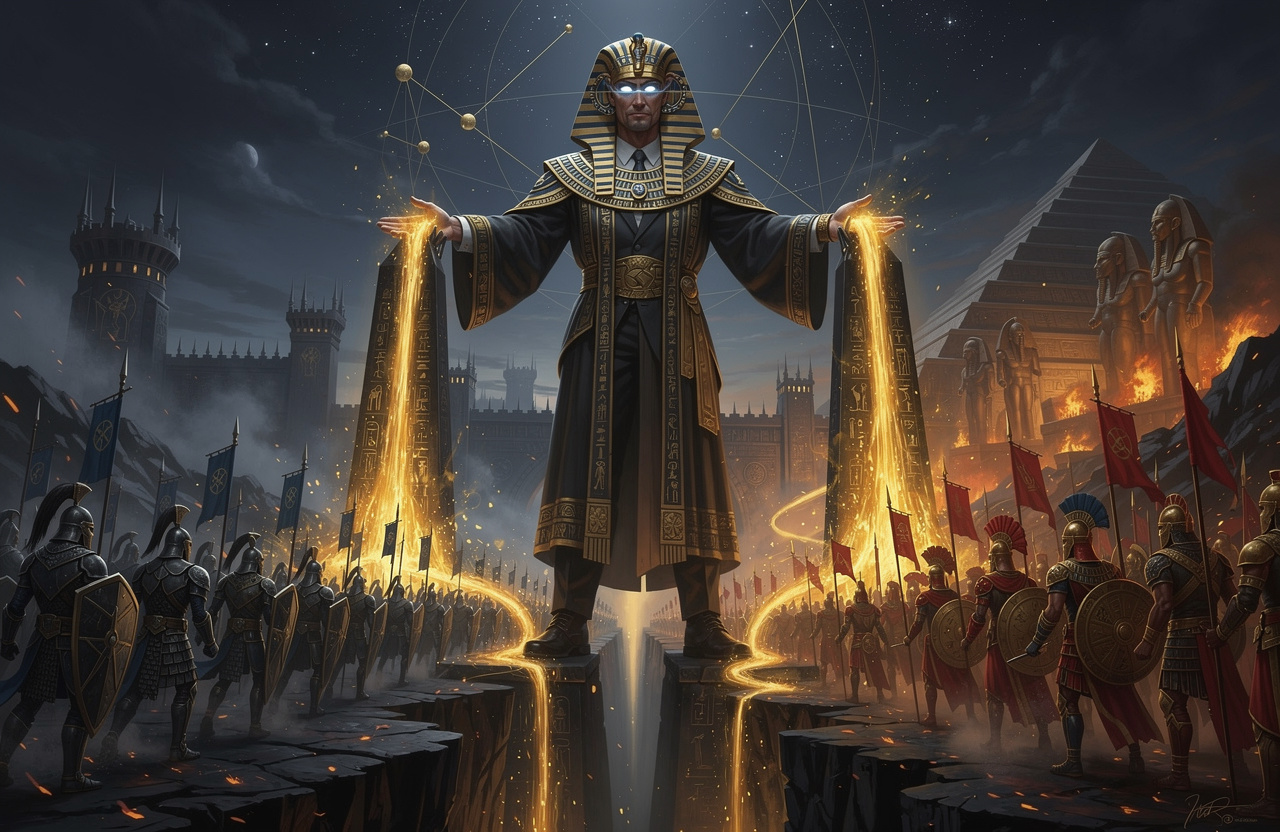
There is a question that breaks the familiar picture of the world faster than any other: what if the people who financed Nazi Germany and the people who financed the Soviet Union were partly the same people? Not ideologues, not agents, but the banks and corporations of Wall Street, for whom both Hitler and Stalin were simply large clients.
It sounds like conspiracy theory. But it is the thesis of a thoroughly academic economist who did not shout it in a square — he backed it with corporate reports, archival documents and numbers. His name was Antony Sutton.
Who Sutton was
Antony Sutton was a British-American economist and, in the 1960s, a research fellow at the Hoover Institution at Stanford — a thoroughly respectable, non-fringe platform. There he produced the multi-volume study Western Technology and Soviet Economic Development. His conclusion was dry, and the dryness made it uncomfortable: a significant part of Soviet industry — factories, technology, equipment — was built and outfitted by Western, primarily American, companies. The very industrialization the USSR was so proud of rode in large part on imported Western engineering.
This fit badly with the logic of the Cold War. It meant that capitalism was busily building factories for its "deadly ideological enemy." After Sutton's conclusions became politically inconvenient, his career at the Hoover Institution ended.
Three books that join the picture
Sutton then wrote the trilogy that made him known:
- Wall Street and the Bolshevik Revolution
- Wall Street and the Rise of Hitler
- Wall Street and FDR
The logic of the series is simple and, for that reason, hits hard. If you look at who financed the Bolsheviks, who financed Hitler's rise, and who stood behind major political projects in the United States itself — again and again you see the same narrow circle of banks, investment houses and corporations. Not because they "loved communism" or "loved Nazism," but because any revolution, any regime, any war is an enormous order: loans, supplies, concessions, contracts.
The thesis that matters more than the details
Sutton's details are disputed, and that is fine — historians refine the scale, contest individual links. But his main thesis is far sturdier than the particulars, and it goes like this: big financial capital is indifferent to ideology. It cares not about the victory of the "right" side, but about the existence of sides at all — because conflict is a market.
An engineer would frame it as the fault-tolerance principle from the Rothschild story. If you have nodes on both sides of a conflict, you cannot lose. Finance Germany — you profit from its rearmament. Finance the USSR — you profit from its industrialization. Bring them together in war — you profit from the war, from the reconstruction, from the debts of both sides. The bet sits on both colors of the roulette wheel at once.
Where fact ends and myth begins
Let's draw the line honestly, because Sutton gets dragged into both extremes. Myth: "Sutton proved that a single hidden headquarters runs the world and deliberately staged the revolution, Hitler and the war according to one plan." Sutton himself did not go to that hard determinism, and the conspiracy theorists who read him that way make more of him than he wrote.
Fact: Sutton documented that Western banks and corporations took part in financing and outfitting both Soviet Russia and Nazi Germany, and that this participation is poorly explained by ideology but explained perfectly by profit. These are confirmed corporate and archival data, not guesses.
And here is the conclusion that makes all of it worth reading. You do not need a "single headquarters" and a secret plan to get that very picture. A simple rule suffices: capital flows to where the return is, paying no attention to the flag. A network of banks placed above states objectively profits from any conflict between them — even without a single conspiracy, simply by following its own logic. This is Isfet at the geopolitical scale: a structure feeding on the conflict of the living while risking nothing itself.
Why he was pushed out
Sutton's own story is a separate lesson. He was not a dissident or a provocateur. He was a careful economist who published what he found in, broadly, open sources. And it was precisely for this that he was squeezed out of the academic system. That says more than his books do: what proved inconvenient was not a lie, but facts assembled together.
Where is the ordinary person
He is the one sold the ideology. He is told: here is our order, there is the enemy's, go and die for the difference between them. And above that difference, the same network finances both sides and reaps the harvest from both. The ordinary person is divided by flags precisely so that he never asks the main question: who finances all the flags at once?
The answer: the MAAT token and DAO
If above people divided into camps stands capital that does not care which camp you are in, then the answer is not to pick the "right" camp. The answer is to build a structure equally indifferent to the imposed flags — but one that works for people, not above them.
That is MAAT. The MAAT token is membership in a cooperative and a single vote, on the principle one human, one vote, above any flags and ideologies used to set us against each other. Governance runs through a DAO, a decentralized organization with a transparent treasury where every movement of funds is visible, and where no one can quietly "bet on both colors" at the members' expense. Sutton showed that the financiers' network wins on any side. We are simply building a network that, for the first time, plays on the side of the ordinary person. The entry is simple: read the book, take the token, get your vote.